Monday, 25 April 2016
Blavatsky on the I-Ching or Book of Changes
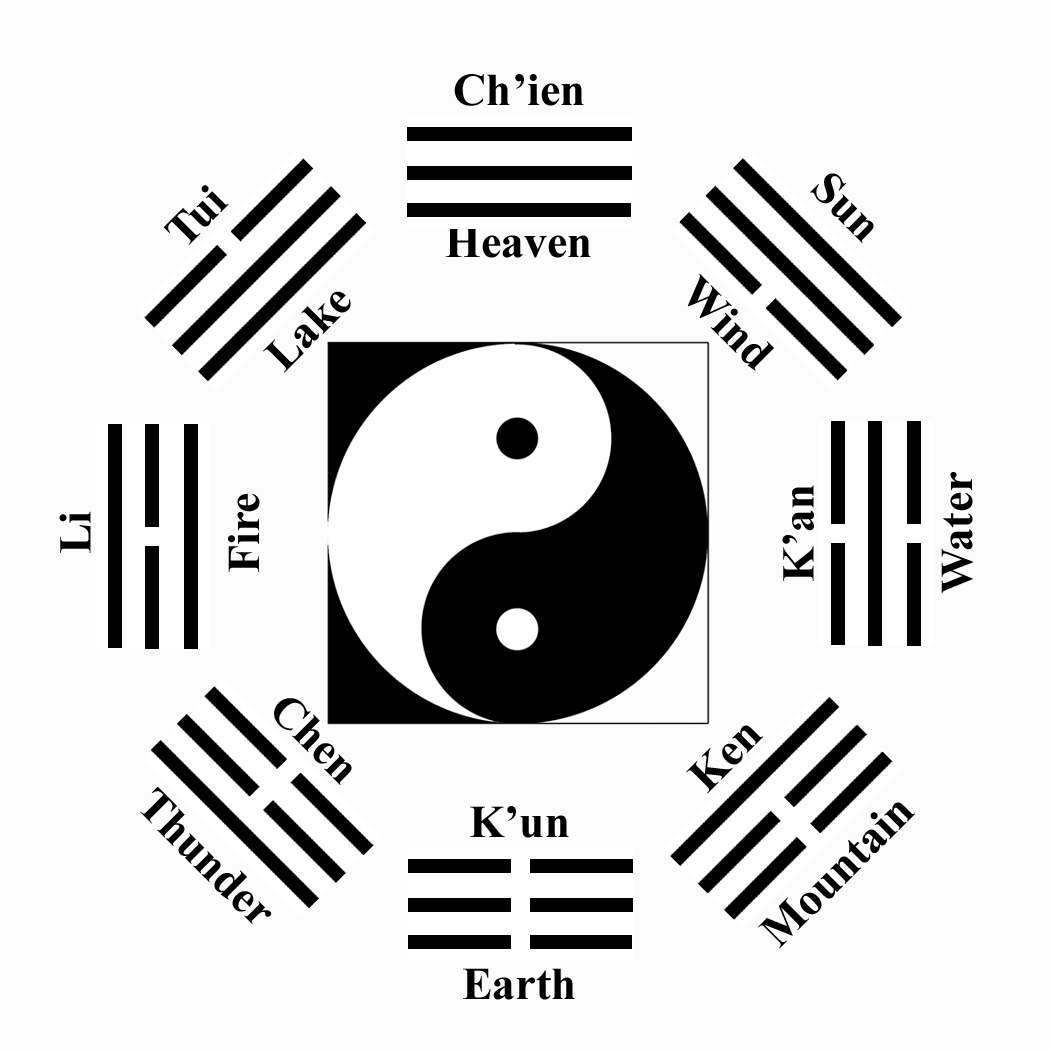
The “great Extreme” as the commencement “of changes” (transmigrations) is the shortest and perhaps the most suggestive of all Cosmogonies, for those who, like the Confucianists, love virtue for its own sake, and try to do good unselfishly without perpetually looking to reward and profit.
The “great Extreme” of Confucius produces “two figures.” These “two” produce in their turn “the four images”; these again “the eight symbols.” It is complained that though the Confucianists see in them “Heaven, Earth and man in miniature,” . . . we can see in them anything we like. No doubt, and so it is with regard to many symbols, especially in those of the latest religions. But they who know something of Occult numerals, see in these “figures” the symbol, however rude, of a harmonious progressive Evolution of Kosmos and its beings, both the Heavenly and the Terrestrial. And any one who has studied the numerical evolution in the primeval cosmogony of Pythagoras (a contemporary of Confucius) can never fail to find in his Triad, Tetractis and Decade emerging from the one and solitary Monad, the same idea. Confucius is laughed at by his Christian biographer for “talking of divination” before and after this passage, and is represented as saying: “The eight symbols determine good and ill fortune, and these lead to great deeds. There are no imitable images greater than heaven and earth. There are no changes greater than the four seasons (meaning North, South, East and West, et seq.). There are no suspended images brighter than the sun and moon. In preparing things for use, there is none greater than the sage. In determining good and ill-luck there is nothing greater than the divining straws and the tortoise.”*
Therefore, the “divining straws” and the “tortoise,” the “symbolic sets of lines,” and the great sage who looks at them as they become one and two, and two become four, and four become eight, and the other sets “three and six,” are laughed to scorn, only because his wise symbols are misunderstood.
† If he rejected it, it was on the ground of what he calls the changes — in other words, rebirths — of man, and constant transformations. He denied immortality to the personality of man — as we do — not to man." (The Secret Doctrine I, p. 440-41)
Friday, 15 April 2016
12 Theosophical Books that Changed the World
It is now generally accepted that the early Theosophical Society was tremendously influential. Why was that so? One reason can be found by taking a glance at some of the early publications. The twelve works presented below are all in their own way, very remarkable, original, innovative works. Many of them were very successful, had a stunning level of erudition, and/or have become spiritual classics. Note that the important classic works of Blavatsky and William Q. Judge have not been included; therefore even without the major works of two of the main founders, the early theosophical literature gives evidence of an intellectual force to be reckoned with and these works all remain compelling reading today.
https://books.google.ca/books?id=X2lsCgAAQBAJ&pg=PT85&lpg=PT85&dq=blavatsky+ralston+skinner+theosophical&source=bl&ots=eACV2aYFYC&sig=054qDK7yTB2j1iaxhlbk5beQsQA&hl=en&sa=X&ved=0ahUKEwichNj1wpHMAhUkx4MKHcO8Ap0Q6AEINjAF#v=onepage&q=blavatsky%20ralston%20skinner%20theosophical&f=false
James Ralston Skinner (1830-1893) was an attorney, a very learned freemason and kabbalist from Cincinnati, Ohio whose correspondence with Blavatsky has survived. http://www.theosophy.wiki/en/James_Ralston_Skinner
2. Henry Steel Olcott – Buddhist Catechism (1881)
http://www.theosophy.wiki/en/Alfred_Percy_Sinnett
Friday, 8 April 2016
William Q. Judge on Critical Thinking
As we understand the rule, it is that we should at all times keep a clear and distinct boundary between what we know, and what we only accept provisionally on the testimony of those who have had larger experience until we reach a point of view from which we can see its truth. We owe it to ourselves to enlarge the sphere of clear knowledge and to push back as far as possible the boundary of opinion and hypothesis.
The realm of knowledge has various departments. Our physical senses furnish us one class of knowledge; our intellectual powers investigate another field on mathematical lines; and yet another faculty enables us to apprehend ethical teachings and to trace them to their true basis in Karma. That we have other faculties, now largely latent, which when developed will enable us to enter other fields of observation and investigation, is beginning to be seen and appreciated."
From "Rounds and Races", The Path, December, 1892
image courtesy of:
https://secularpolicyinstitute.net/
Saturday, 2 April 2016
Blavatsky on Spiritual Resurrection
"Two things become evident to all in the above passages (Matthew, 24:4-30), now that their false rendering is corrected in the revision text: (a) "the coming of Christ," means the presence of CHRISTOS in a regenerated world, and not at all the actual coming in body of "Christ" Jesus;
(b) this Christ is to be sought neither in the wilderness nor "in the inner chambers," nor in the sanctuary of any temple or church built by man; for Christ — the true esoteric SAVIOR — is no man, but the DIVINE PRINCIPLE in every human being.
He who strives to resurrect the Spirit crucified in him by his own terrestrial passions, and buried deep in the "sepulcher" of his sinful flesh; he who has the strength to roll back the stone of matter from the door of his own inner sanctuary, he has the risen Christ in him.(3) The "Son of Man" is no child of the bond-woman — flesh, but verily of the free-woman — Spirit (4), the child of man's own deeds, and the fruit of his own spiritual labor. "
"The first key that one has to use to unravel the dark secrets involved in the mystic name of Christ, is the key which unlocked the door to the ancient mysteries of the primitive Aryans, Sabeans and Egyptians. The Gnosis supplanted by the Christian scheme was universal. It was the echo of the primordial wisdom-religion which had once been the heirloom of the whole of mankind; and, therefore, one may truly say that, in its purely metaphysical aspect, the Spirit of Christ (the divine logos) was present in humanity from the beginning of it.
The author of the Clementine Homilies is right; the mystery of Christos — now supposed to have been taught by Jesus of Nazareth — "was identical" with that which from the first had been communicated "to those who were worthy," as quoted in another lecture. (16) We may learn from the Gospel according to Luke, that the "worthy" were those who had been initiated into the mysteries of the Gnosis, and who were "accounted worthy" to attain that "resurrection from the dead" in this life . . . . "those who knew that they could die no more, being equal to the angels as sons of God and sons of the Resurrection."
In other words, they were the great adepts of whatever religion; and the words apply to all those who, without being Initiates, strive and succeed, through personal efforts to live the life and to attain the naturally ensuing spiritual illumination in blending their personality — (the "Son") with (the "Father,") their individual divine Spirit, the God within them.
This "resurrection" can never be monopolized by the Christians, but is the spiritual birth-right of every human being endowed with soul and spirit, whatever his religion may be. Such individual is a Christ-man. On the other hand, those who choose to ignore the Christ (principle) within themselves, must die unregenerate heathens — baptism, sacraments, lip-prayers, and belief in dogmas notwithstanding. " (Blavatsky - The Esoteric Character of the Gospels, part I, Lucifer, Nov. 1887)
painting by: Mikhail Vrubel , Kiev 1887
Thursday, 24 March 2016
The Spiritual Meaning of Easter 2
"The whole course of the typical life of the Pattern Man is emblematic of the progressive development of the life begun on earth, completed in heaven (so to use your terms), born of self-denial, and culminating in spiritual ascension. In the Christ life, as in a story, man may read the tale of the progress of spirit from incarnation to enfranchisement. Thirty years and more of angelic preparation fitted the Christ for His mission: three short years sufficed to discharge so much of it as man could bear. So man's spirit in its development progresses through the course covered by the Festivals of the Christian Church, from the birth of self-denial to the festival of the completed life. Born in self-denial, progressing through self-sacrifice, developed by perpetual struggles with the adversaries (the antagonistic principles which must be conquered in daily life, in self, and in the foes), it dies at length to the external, and rises on its Easter morn from the grave of matter, and lives henceforth, baptized by the outpoured spirit of Pentecost, a new and risen life, till it ascends to the place prepared for it by the tendency of its earth life.
Spirit Teachings, Section 30, William Stainton Moses
Sunday, 20 March 2016
Astrology: Lunar Eclipse - March 23, 2016
Coming four days after the Spring equinox, this lunar eclipse highlights the transition from submersion in the Piscean mystical waters to the rebirth into the manifesting energies of Aries; the renewal of spring, marking the end of the zodiacal initiatory cycle and the beginning of a new cycle of experience and transformation.
Aries-Libra Axis
This is the final sequence of Aries-Libra eclipses begun in October 2013 and so can represent a culmination of relationship issues focused on individual needs versus relational needs. The challenge of harmonizing one’s personal needs with the needs of others will not be so easy as the Sun/Mercury conjunction, in the sign of Aries, in a Trine with Mars (in Sagittarius) gives a powerful energy for vocal self-assertion (there will be no lack of loquaciousness), whereas the moon’s effectiveness is muted in Libra and the sextile aspect with Mars is less powerful; and with a full moon, emotional energy can be strong. Hence the balance between intellect and emotion is a major challenge with this eclipse.
Saturn-Neptune-Jupiter T-Square
This powerful T-Square is strongly balanced by Neptune/Pluto, Saturn/Uranus and Jupiter/Pluto trines; along with the Uranus/Pluto square, the outer planets are all inter-connected by powerful aspects, bringing socio-political changes in areas of bureaucratic/political power (Pluto in Capricorn), philosophical ideologies (Saturn in Sagittarius), religious policies and environmental issues (Jupiter in Virgo), technological developments and social protest (Uranus in Aries) as well as art and spirituality (Neptune in Pisces); and so we are at a pivotal moment in the current outer planetary transits. In the last eclipse, most of the planets were focused around the T-Square, whereas now, all of the inner planets are somewhat inter-spread between these aspects, although still very close to the planets Neptune, Uranus, Jupiter, and Saturn. The Jupiter (retrograde) -Saturn square goes exact practically at the same time as the eclipse occurs and Saturn will go retrograde on March 25th. With all this movement going on, the Venus-Neptune conjunction may perhaps get muted, but it could be quite potent in terms of creative, romantic and spiritual inspiration if one can achieve a strong practical, realistic, grounded balance and discipline, while avoiding the problem of deluded emotionalism. Additionally, the Venus/Neptune trine with Pluto, can serve to favor spiritual insight.
Summary
If one follows the news, one may have noticed how the solar eclipse of March 8th shook things up quite a bit, (and also brought encouraging signs of productive cooperative changes). Perhaps some long-standing problems flared up, or old wounds re-opened. With this eclipse, there is an exceptionally positive energy for completing the zodiacal cycle of transformation and renewal. With five planets in fire signs and the Uranus, Pluto, Saturn and Mars squares, a certain amount of dramatic volatility can be expected; moreover, the strong Jupiter-Saturn square can bring dramatic change in one’s life structure (a change to allow for a more fluid organization). The main challenge with this eclipse would be to take care to use the mercurial masculine individualistic, intellectual insightfulness in a holistic manner that integrates the more feminine, emotional, intuitive, altruistic aspects of the full moon in Libra. Hence, one would do well to consider diplomacy, listening skills, and empathy in one’s drive to engage in resolving lingering problems and disputes.
As a possible hint to the deeper meanings of this eclipse, I suggest the above image of the alchemical Rebus as envisaged by Basile Valentin from FIGVRA XCVIII (48), Viridarium chimicum (1624) by Daniel Stolcius. For a good explanation of this symbol see:
http://www.freemasons-freemasonry.com/double-headed-eagle.html
Sunday, 13 March 2016
Gauri Viswanathan on the Mahatma Letters
Just to clarify, of course A.P. Sinnett's Esoteric Buddhism is almost completely based on letters from the Mahatma Letters to A.P. Sinnett; and obviously, reincarnation is a central aspect of both works, and was the first major exposition of the theosophical ideas on this question and remains a classic exposition thereof - even Blavatsky's exposition on reincarnation in Key to Theosophy seems based mainly on the Mahatma Letters.
“Reading Theosophy-as one among many so-called fringe spiritual movements of the nineteenth century-poses the sorts of challenges to critical thinking that secular intellectuals would prefer not to contemplate. A cosmopolitan movement that acquired worldwide adherents, Theosophy developed in reaction to orthodox Christianity, as it sought the roots of spiritual life not in dogma but in an experiential religion recapturing a non-deity-centered, pantheistic theology. Its appeal lay in finding a common ground between many world religions, without necessarily subscribing to the tenets of any one particular religion. Although it is sometimes grouped along with other spiritualist cults, it is necessary to distinguish it from the more plebian movements with which spiritualism was often identified.” (p. 4)
ps.
varia: upcoming lecture on theosophy at McGill University https://www.mcgill.ca/creor/files/creor/gauri_viswanathan_poster_2016.pdf


