Showing posts with label symbolism. Show all posts

Tuesday, 13 June 2023

Astrological Symbolism: Taurus, part 2

Rulership of Venus
Blavatsky relates some ideas of Kabbalist J. Ralston Skinner on Venus as ruler of Taurus:
'The author's idea is to show the mystic blending by the Gospel writers of Jehovah, Cain, Abel, etc., with Jesus (in accordance with Jewish kabalistic numeration); the better he succeeds, the more clearly he shows that it was a forced blending, and that we have not a record of the real events of the life of Jesus, narrated by eyewitnesses or the Apostles. The narrative is all based on the signs of the Zodiac: Each a double sign or male-female [ in ancient astrological Magic] - viz.: it was Taurus-Eve, and Scorpio was Mars-Lupa, or Mars with the female wolf [ in relation to Romulus]. (Page 154) So, as these signs were opposites of each other, yet met in the centre, they were connected; and so in fact it was, and in a double sense, the conception of the year was in Taurus, as the conception of Eve by Mars, her opposite, in Scorpio. The birth would be at the winter solstice, or Christmas.
1-Venus, Ruler of Taurus & Libra
On the contrary, by conception in Scorpio - viz., of Lupa by Taurus - birth would be in Leo. Scorpio was Chrestos in humiliation, while Leo was Christos in triumph. While Taurus-Eve fulfilled astronomical functions, Mars-Lupa fulfilled spiritual ones by type. [ Op. cit.,296.] The author bases all this on Egyptian correlations and meanings of Gods and Goddesses, but ignores the Aryan, which are far earlier. Mooth or Mouth, was the Egyptian cognomen of Venus, (Eve, mother of all living) [as Vach, mother of all living, a permutation of Aditi, as Eve was one of Sephira] or the moon.' (Isis I, 374).
Blavatsky adds: ‘Isis was sometimes called Muth, which word means mother . . . (Issa, אשח woman). (Isis, p.372). Moreover: ‘Isis, he says is that part of Nature, which, as feminine,contains in herself, as (nutrix) nurse, all things to be born. . . “Certainly the moon, “ speaking astronomically, “chiefly exercises this function in Taurus, Venus being the house (in opposition to Mars, generator, in Scorpio), because the sign is luna, hypsoma.  (Secret Doctrine 3, 127-28)
2-Europa & Zeus as white bull
Greece
In Greek tradition, the sign is customarily related to the myth of Europa. Europa was the daughter of Argiope and Agenor, a Sidonian. Jupiter, changing his form to that of a bull, carried her from Sidon to Crete, and begat by her Minos, Sarpedon, and Rhadamanthus. Her father Agenor sent his sons to bring their sister back, or else not to return to his sight. Phoenix set out for Africa, and there remained. From this the Africans are called Phoenicians. Cilix from his own name gave the name to Cilicia. Cadmus in his wanderings came to Delphi. There the oracle told him to buy from farmers an ox which had a moon-shaped mark on its side, and to drive it before him. Where it lay down it was fated that he found a town and rule. When Cadmus heard the oracle, he did as he was told. While seeking water he came to the fountain of Castalia, which a dragon, the offspring of Mars, was guarding. It killed the comrades of Cadmus, but was killed by Cadmus with a stone. Under Minerva's instructions he sowed the teeth and ploughed them under. From them sprang the Sparti. These fought themselves, but from them five survived, namely, Chthonius, Udaeus, Hyperenor, Pelorus, and Echion. Moreover, Boeotia was named from the ox Cadmus followed. (Hyginus, Fabulae, § 178  EUROPA)
3-Hyades saving Alcmena
Graeco Roman myths relate stories pertaining to the Hyades, a major constellation of Taurus.
The face of Taurus is marked by the V-shaped group of stars called the Hyades (Ὑάδες in Greek). Ovid in his Fasti asserts that the name comes from the old Greek word hyein, meaning ‘to rain’, so that Hyades means ‘rainy ones’, because their rising at certain times of year was said to be a sign of rain. In mythology the Hyades were the daughters of Atlas and Aethra the Oceanid. Their eldest brother was Hyas, a bold hunter who one day was killed by a lioness. His sisters wept inconsolably – Hyginus says they died of grief – and for this they were placed in the sky. Hence it seems equally likely that their name comes from their brother Hyas. In another story, the Hyades were nymphs who nursed the infant Dionysus in their cave on Mount Nysa, feeding him on milk and honey. The Romans had a different name: they called the Hyades suculae meaning ‘piglets’. (Ian Ridpath, Star Tales)
Another major constellation in Taurus, the Pleiades , is also part of Greek mythical tradition:
4- the Pleiades
Even more famous than the Hyades is another star cluster in Taurus: the Pleiades (
Πλειάδες in Greek), commonly known as the Seven Sisters. To a casual glance, the Pleiades cluster appears as a fuzzy patch like a swarm of flies over the back of the bull. According to Hyginus, some ancient astronomers called them the bull’s tail. So distinctive are the Pleiades that the ancient Greeks regarded them as a separate mini-constellation and used them as a calendar marker. Hesiod, in his agricultural poem Works and Days, instructs farmers to begin harvesting when the Pleiades rise at dawn, which in Greek times would have been in May, and to plough when they set at dawn, which would have been in November. 
In mythology the Pleiades were the seven daughters of Atlas and the oceanid Pleione, after whom they are named. One popular derivation is that the name comes from the Greek word plein, meaning ‘to sail’ – so Pleione means ‘sailing queen’ and the Pleiades are the ‘sailing ones’, because in Greek times they were visible all night during the summer sailing season. When the Pleiades vanished from the night sky, it was considered prudent to remain ashore. ‘Gales of all winds rage when the Pleiades, pursued by violent Orion, plunge into the clouded sea’, wrote Hesiod. Alternatively, and possibly more likely, the name may come from the old Greek word pleos, ‘full’, which in the plural meant ‘many’, a suitable reference to the cluster. According to other authorities, the name comes from the Greek word peleiades, meaning ‘flock of doves’.
5- Orion
A famous myth links the Pleiades with Orion. As Hyginus tells it, Pleione and her daughters were one day walking through Boeotia when Orion tried to ravish her. Pleione and the girls escaped, but Orion pursued them for seven years. Zeus immortalized the chase by placing the Pleiades in the heavens where Orion follows them endlessly.  (Ian Ridpath, Star Tales)
Rome
Ovid recounts how the feast of Nefastus  on April 20:  (vv. 713-720) marks the Sun’s entrance into Taurus:
When Memnon's saffron(-robed) mother (i.e. Aurora) next comes to view the broad earth on her rosy steeds, the Sun abandons the leader of the woolly flock who betrayed Helle (i.e. Aries, the Ram): a greater victim is there in his path (i.e. the constellation of Taurus): its front is evident, (but) its hind-parts are hidden. But whether this star-sign is a bull (i.e. the bull which had carried Europa) or a heifer (i.e. the heifer into which Io had been transformed), it has its reward for love-making against the wishes of Juno (Ovid, Fastii, Book 4, April).
Judaism
In terms of Kabbalistic symbolism, Blavatsky states that: ‘Taurus is under the asterisk A, which is its figure in the Hebrew alphabet, that of Aleph; and therefore that constellation is called the “ One ”, the “ First ”, after the said letter. Hence, the “ First-born” to all of whom it was made sacred.’ (Blavatsky, Taurus, Theosophical Glossary)
According to Shaul Youdkevitch: ‘The symbol of the astrological sign of Taurus is an ox. In the story of the Merkava, in the book of Ezekiel, Ch. 1, the Left Column (the desire to receive for the self alone) is symbolized by the ox. This image of the Left Column, symbolized by the ox, can be found in many places in the Bible and in many other writings of Kabbalah.’
Christian
6-Tetramorph, Bull symbol, Luke
The animals associated with the Christian tetramorph originate in the Babylonian symbols of the four fixed signs of the zodiac: the ox representing Taurus; the lion representing Leo; the eagle representing Scorpio; the man or angel representing Aquarius. (Mesocosm, The Tetramorph; The Sumerian Origins of a Christian Symbol)
Historically speaking, Rupert Gleadow gives some basic considerations concerning the origin of the symbol: The Bull on the other hand is not Egyptian. Had it been so, then its ruler, when ruling planets were allotted, should have been Saturn and not Venus, just as Mars would have been the ruler of Leo. The Egyptians called Saturn 'Horus the Bull of Heaven', and bulls are not uncommon in Egyptian astronomy, but they are not attached, like the Babylonian Gud.anna, to this part of the sky (The Origin of the Zodiac, 1968 212-213).
 
Images References
2- Apulian Red Figure Kylix ca 330 - 320 B.C. https://www.theoi.com/Gallery/K1.8.html
3- The Hyades saving Alcmena. Wilhelm Heinrich Roscher (Göttingen, 1845- Dresden, 1923), Ausfürliches Lexikon der griechisches und römisches Mythologie, 1884. https://www.maicar.com/GML/HYADES1.html 
5- Ceiling Frescoe, Villa Farnese - MAP OF THE HEAVENS - Giovanni Antonio da Varese - 1575 https://www.peoplesguidetothecosmos.com/constellations/orion.htm

Thursday, 8 June 2023

Astrological Symbolism: Taurus, part 1

H.P. Blavatsky describes Taurus as a ‘most mysterious constellation of the Zodiac, one connected with all the “First-born” solar gods. The Bull is the symbol of force and procreative power—the Logos’ (Blavatsky ‘Taurus’, Theosophical Glossary). Moreover, the ‘worship of the Bull and the Ram was addressed to one and the same power, that of generative creation, under two aspects— the celestial or cosmic, and the terrestrial or human. The ram-headed gods all belong to the latter aspect, the bull—to the former. the emblems of the generative, or of evolutionary power in the Universal Kosmos’
(Blavatsky, Bull-Worship, Theosophical Glossary).
She gives a general overview of the Bull symbol in different traditions: ‘The bull Nardi, the vehan of Siva and the most sacred emblem of this god, is reproduced in the Egyptian Apis; and in the bull created by Ormazd and killed by Ahriman. The religion of Zoroaster, all based upon the "secret doctrine," is found held by the people of Eritene; it was the religion of the Persians when they conquered the Assyrians. From thence it is easy to trace the introduction of this emblem of LIFE represented by the Bull, in every religious system. The college of the Magians had accepted it with the change of dynasty; Daniel is described as a Rabbi, the chief of the Babylonian astrologers and Magi (Book of Daniel, iv,v); therefore we see the Assyrian little bulls and the attributes of Siva reappearing under a hardly modified form in the cherubs of the Talmudistic Jews, as we have traced the bull Apis in the sphinxes or cherubs of the Mosaic Ark; and as we find it several thousand years later in the company of one of the Christian evangelists Luke’ (Isis Unveiled 2, 235-6).
1-Nandi [Bull] 2nd c. AD Mysore
Nandi is the bull vahana of the Hindu god Shiva. He is also the guardian deity of Kailash, the abode of Shiva. Almost all Shiva temples display stone-images of a seated Nandi, generally facing the main shrine. According to Saiva Siddhanta, Nandeeswarar is considered to be chief among the Siddhars, initiated by Mother Parvati and Father Shiva. He passed on what he had learned to his 8 disciples, namely, the Four Kumaras, Sundaranandar who later becomes Tirumular by a chance happening, Vyagrapada (also known as Pullipani), Patanjali, and Sivayoga Muni. They were sent out in eight different directions, to spread wisdom (Gopinatha Rao, T. A. (1997). Elements of Hindu Iconography, Volume 2. Motilal Banarsidass Publishers. p. 213).  Subba Row gives an esoteric account of the Hindu astrological symbol:  Rishabha. This word is used in several places in the Upanishats and the Veda to mean Pranava (Aum). Shankarâchârya has so interpreted it in several portions of his commentary. [Example: RishabhasyaChhandasam Rishabhasya Pradhânasya Pranavasya]  

2- Nandi, zoo-anthropomorphic form
For the Egyptian symbolism, Blavatsky gives a rather specific instance of the god Apis: “It is not simple chance,” we are told, “that has placed in certain spheres, on a throne, the head of that bull (Taurus), trying to push away with the ansated cross on its horns, a Dragon; the more so, since this constellation of Taurus was called ‘the great city of God and the mother of revelations,’ and also ‘the interpreter of the divine voice,’ the Apis pacis of Hermoutis, in Egypt, which (as the patristic fathers would assure the world) preferred oracles that related to the birth of the Saviour” (Pneumatologie, iv., 71) …  The serpent was the symbol of Wisdom; and the Bull (Taurus) the symbol of physical or terrestrial generation. Thus the latter, pushing off the Dragon, or spiritual, Divine Wisdom, with the Tau, or Cross — which is esoterically “the foundation and framework of all construction” (Secret Doctrine 1, 657) . Moreover, the 'black bull Mnevis, the son of Ptah, was sacred to the God Ra at Heliopolis; the Pacis of Hermonthis—to Amoun Horus, &c., &c., and Apis himself was a hermaphodite and not a male animal, which shows his cosmic character' (Blavatsky, Bull-Worship, Theosophical Glossary).

3- Apis, Bull with moon, 1823-25

Regarding Apis in the form a bull, this animal was chosen because it symbolized the courageous heart, great strength, and fighting spirit of the king. Apis came to being considered a manifestation of the king, as bulls were symbols of strength and fertility, qualities that are closely linked with kingship. "Strong bull of his mother Hathor" was a common title for Egyptian gods and male kings, being unused for women serving as king, such as Hatshepsut.

As early as the time of the Narmer Palette, the king is depicted with a bovine tail on one side, and a bull is seen knocking down the walls of a city on the other.  Occasionally, Apis was pictured with the sun-disk symbol of his mother, Hathor, between his horns, being one of few deities ever associated with her symbol. When the disk was depicted on his head with his horns below and the triangular marking on his forehead, an ankh was suggested. That symbol always was closely associated with Hathor.

4-Apis statue
Early on, Apis was the herald (wḥm) of Ptah, the chief deity in the area around Memphis. As a manifestation of Ptah, Apis also was considered to be a symbol of the king, embodying the qualities of kingship. In the region where Ptah was worshiped, cattle exhibited white patterning on their mainly black bodies, and so a belief grew up that the Apis calf had to have a certain set of markings suitable to its role. It was required to have a white triangular marking upon its forehead, a white Egyptian vulture wing outline on its back, a scarab mark under its tongue, a white crescent moon shape on its right flank, and double hairs on his tail.

The calf that matched these markings was selected from the herds, brought to a temple, given a harem of cows, and worshiped as an aspect of Ptah. The cow who was his mother was believed to have conceived him by a flash of lightning from the heavens, or from moonbeams. She also was treated specially, and given a special burial. At the temple, Apis was used as an oracle, his movements being interpreted as prophecies. His breath was believed to cure disease and his presence to bless those around with strength. A window was created in the temple through which he could be viewed and, on certain holidays, he was led through the streets of the city, bedecked with jewelry and flowers (Griffith, Francis Llewellyn (1911). "Apis". In Chisholm, Hugh (ed.). Encyclopædia Britannica. Vol. 2 (11th ed.). Cambridge University Press. p. 168).

Blavatsky also points out the story of the bull in the Zoroastrian Avesta: 
5- Persepolis mural: death of Gavaevodata
Kain, presiding over the Taurus (Bull) of the Zodiac, is also very suggestive. Taurus belongs to the earthy trigon, and in connection with this sign it will not be amiss to remind the student of an allegory from the Persian Avesta. The story goes that Ormazd produced a being — source and type of all the universal beings — called LIFE, or Bull in the Zend. Ahriman (Cain) kills this being (Abel), from the seed of which (Seth) new beings are produced.
(Isis Unveiled 2, 465).
 
6- Gozu Tenno
The Bundahishn of the Middle Persian era tells of the world created by the deity Ahura Mazda. The great mountain, Alburz, grew for 800 years until it touched the sky. From that point, rain fell, forming the Vourukasha sea and two great rivers. The first animal, the white
bull, lived on the bank of the river Veh Rod.
Gavaevodata is the Avestan language name of the primordial bovine of Zoroastrian cosmogony and cosmology, one of Ahura Mazda's six primordial material creations and the mythological progenitor of all beneficent animal life. However, the evil spirit, Angra Mainyu, killed it. Its seed was carried to the moon and purified, creating many animals and plants (Boyce, Mary (1975), A History of Zoroastrianism, vol. 1, Leiden: Brill, pp. 138–139)
Jean-Marie Ragon relates how the bull in Japanese myths relates to this sign (La Messe et ses Mysteres, 1844, p. 347). With the fusion of Shinto and Buddhism, Susa-no-O was identified with GozuTenno ("Bull-headed King of Heaven"). 
Image References
5- Persepolis mural: The death of Gavaevodata/Gawiewdad, the primordial bovine, whose cithra is rescued by the moon. https://www.wikiwand.com/en/Mah 
6- Ox-Headed Deva King, gozu tenno 牛頭天王 The Japanese god of plague https://heianperiodjapan.blogspot.com/2015/09/gozu-tenno-legends.html
 

Thursday, 18 May 2023

Astrological Symbolism: Aries, part 2

Karnak Temple in Luxor

Part  1 

Egypt

For the Egyptain gods related to the symbol of the ram, Blavatsky mentions Ammon, Khnoum, and Kneph.

Champollion lists the following as forms of Amon:Amon-Ra, Nef, Noub, Noum, Cnèph, Cnouphis-ilus, Cnoubis, Chnoumis, Agathodaemon, Mendes. (Panthéon égyptien, collection des personnages mythologiques de l'ancienne Égypte, d'après les monuments, Firmin Didot (pp. 1-24).

According to Mythopedia, Amon is one of 'the most important gods in the Egyptian pantheon, ram-headed Amun was a key member of the Hermopolitan Ogdoad and the Theban Triad. Amun was often combined with Ra, with whom he shared many cosmological similarities. In their respective cults of worship, each was hailed as a creator deity and the head of the Egyptian pantheon.

Amon-Ra (1)
Amun was somewhat unique within Egyptian theology, as he possessed many characteristics emphasized in modern monotheistic deities (such as Christianity’s God, Judaism’s Yahweh, and Islam’s Allah). Omnipresent and all-powerful, Amun was unknowable even to his fellow gods and goddesses.

Amun was depicted in a variety of ways, with the most common being that of a bearded man wearing a dual-feathered plume. He often wore a short kilt and a feather-patterned tunic. While Amun was frequently depicted as having blue skin, later representations used red as well.

Amun’s other representations included a ram-headed man, a ram-headed serpent, a primordial goose, and a ram-headed sphinx.' (Meehan, Evan. “Amun.” Mythopedia, November 29, 2022)

According to Blavatsky: 'Ammon or Mon, the “hidden,” the Supreme Spirit.  Ammon-Ra, the generator, is the secondary aspect of the concealed deity. Khnoum was adored at Elephanta and Philoe) The same with Khnoum and Ammon;§ both are represented ram-headed, and both often confused, though their functions are different. Khnoum is “the modeller of men,” fashioning men and things out of the Mundane Egg on a potter’s wheel;' (Isis Unveiled 2, 465)
Cnouphis, Chnoubis, Ammon-Chnoubis (2)

She gives certain elaborations on the various forms of Amon in her Theosophical Glossary:

Ammon (Eg.). One of the great gods of Egypt. Ammon or Amoun is far older than Amoun-Ra, and is identified with Baal. Hammon, the Lord of Heaven. Amoun-Ra was Ra the Spiritual Sun, the “Sun of Righteousness”, etc., for—“the Lord God is a Sun”. He is the God of Mystery and the hieroglyphics of his name are often reversed. He is Pan, All-Nature esoterically, and therefore the universe, and the “Lord of Eternity”. Ra, as declared by an old inscription, was “begotten by Neith but not engendered”.

Kneph (Eg.). Also Cneph and Nef, endowed with the same attributes as Khem. One of the gods of creative Force, for he is connected with the Mundane Egg. Deveria writes: “His journey to the lower hemisphere appears to symbolise the evolutions of substances which are born to die and to be reborn”. Thousands of years before Kardec, Swedenborg, and Darwin appeared, the old Egyptians entertained their several philosophies. (Eg. Belief and Mod. Thought.)

Chnouphis
 Khnum creating man and woman (3)
(Gr.)(here she seems to be describing the form of Khnoum) Nouf in Egyptian. Another aspect of Ammon, and the personification of his generative power in actu, as Kneph is of the same in potentia. He is also ram-headed. If in his aspect as Kneph he is the Holy Spirit with the creative ideation brooding in him, as Chnouphis, he is the angel who “comes in” into the Virgin soil and flesh.
He is seen on a monument seated near a potter’s wheel, and forming men out of clay. The fig-leaf is sacred to him, which is alone sufficient to prove him a phallic god—an idea which is carried out by the inscription: “he who made that which is, the creator of beings, the first existing, he who made to exist all that exists.” Some see in him the incarnation of Ammon-Ra, but he is the latter himself in his phallic aspect, for, like Ammon, he is “ his mother’s husband”, i.e., the male or impregnating side of Nature. His names vary, as Cnouphis, Noum, Khem, and Khnum or Chnoumis. As he represents the Demiurgos (or Logos) from the material, lower aspect of the Soul of the World, he is the Agathodæmon, symbolized sometimes by a Serpent ;

Chnoumis (Gr) The same as Chnouphis and Kneph.

Kneph, temple of Khnum, Esna, Egypt (4)
A symbol of creative force ;  The fact is that all these gods are solar, and represent under various aspects the phases of generation and impregnation. Their ram’s heads denote this meaning, a ram ever symbolizing generative energy in the abstract, while the bull was the symbol of strength and the creative function. All were one god, whose attributes were individualised and personified.

Esoterically, however, and as taught by the Initiates of the inner temple, Chnoumis-Kneph was pre-eminently the god of reincarnation. Says an inscription: “I am Chnoumis, Son of the Universe, 700”, a mystery having a direct reference to the reincarnating EGO. 

Greece

Phrixus & Golden-Fleeced Ram,  C 5th B.C (5)
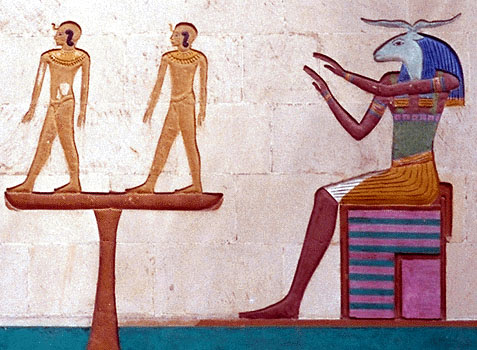
Aries, the first astrological sign, is represented by the ram, with a general symbolism of rebirth and beginnings. Aries, which is ruled by the planet Mars, is associated with the Greek myth of Jason and the Argonauts.The myth tells the story of Phrixus and Helle, who were born of Athamas, a Boetian king, and the goddess of the clouds, Nephele. Athamas fell in love with a woman named Ino, and Nephele left in anger, causing a drought in her wake. Ino attempted to sacrifice Phrixus and Helle in order to end the drought that had stricken the land. Nephele prevented this from happening by sending a ram with golden wool to rescue them. The two children escaped on the winged ram’s back.The ram was initially meant to be sacrificed to Mars, but Zeus took it and placed it in the sky in his honor.
(Hyginus Fabulae 188, Krios Khrysomallos)
Roman  Jupiter Ammon, 1st c, AD (6)
According to Blavatsky, 'In his astronomical aspect Zeus-Dionysus has his origin in the zodiac, the ancient solar year. In Libya he assumed the form of a ram, and is identical with the Egyptian Amun, who begat Osiris, the taurian god. (Isis
Unveiled I, 263 )
Amun, worshipped by the Greeks as Ammon, had a temple and a statue, the gift of Pindar (d. 443 BC), at Thebes (Description of Greece. ix.16 § 1.), and another at Sparta, the inhabitants of which, as Pausanias says, consulted the oracle of Ammon in Libya from early times more than the other Greeks (Description of Greece. iii.18 § 2). At Aphytis, Chalcidice, Amun was worshipped, from the time of Lysander (d. 395 BC), as zealously as in Ammonium. Pindar the poet honored the god with a hymn. At Megalopolis the god was represented with the head of a ram (Paus. viii.32 § 1), and the Greeks of Cyrenaica dedicated at Delphi a chariot with a statue of Ammon.

Rome

Ovid describes the importance of the Ram symbol for the Romans at the Spring equinox, recounting the myth of golden fleece:

March 23: Tubilustrium: Nefas Publicus (ll. 849-876)

The last of the five days (i.e. of the Quinquatria) exhorts (us) to purify the tuneful trumpets, and to offer sacrifice to the mighty goddess (i.e. Nerio, the wife of Mars, with whom Minerva came to be associated). Now you can raise your face to the sun and say, "Yesterday, he touched the fleece of Phrixus' ram (i.e. on 22nd March the sun entered the zodiac constellation of 'Aries', the Ram)."

6th c. mosaic zodiac  in a synagogue (7)  
The seeds were parched by the trick of the wicked stepmother (i.e. Ino), and the grain had not sprouted as it usually (did): (a messenger) had been sent to the oracle to report by a sure prophecy what cure the Delphic (god) would prescribe for the barren earth. Tarnished also like the seed, he reports that the deaths of Helle and of young Phrixus are sought by the oracle. And, when the citizens, and the season, and Ino compelled a reluctant king (i.e. Athamas) to submit to these impious orders, Phrixus and his sister, covering their brows with head-bands, stand together before the altar and bewail their joint fate. Their mother (i.e. Nephele, cloud) sees (them) by chance as she hung in the air, and beats her bare breasts with her hand in shock, and, with the clouds as her companions, she dives down into the dragon-born city (i.e. Thebes, founded by Cadmus, who sowed the dragon's teeth), and snatches her children away from there; and, so that they can make their escape, a ram, gleaming with gold, is provided; it conveys the two (of them) over the wide seas. The girl held on to the left-horn (too) weakly, they say, when she called the name of the water after herself (i.e. the Hellespont, the straits that link the Aegean to the Propontis, or the Sea of Marmora). Her brother almost died with her, when he tries to help (her) as she falls, and he extends his outstretched hands as far as possible. He wept at losing his partner in their twin peril, unaware that she has been joined to the azure god (i.e. Neptune). On reaching the shore, the ram becomes a constellation (i.e. Aries); but his golden fleece arrives at the halls of Colchis (i.e. a city on the eastern sea-coast of the Black Sea). 9 (Ovid, Fastii, Book 3, March)

Judaism

Mosaic in Santi Cosma e Damiano (8)
Blavatsky posits a link between lamb sacrifice in Judaism and the symbolism of Aries (Theosophical Glossary, 'Ammon'). The Torah gives various indications: 'According to the norms regarding sacrifices in the former temple, a lamb could be offered in various situations: a common person could offer a lamb as a sin offering in atonement for his sin (Lev 4,32-35), or as part of a rite of purification (Lev 12,1-8; 14,10-32), or as a communion sacrifice (Lev 3,7-10); the Passover lamb was, in fact, a special type of communion sacrifice (Exod 12,1-14.21-28).' (The Sacrificial Symbolism of the Lamb in the Book of Revelation) According to Saul Youdkevitch: '
We said that the lamb (Aries) represents the ego, and we toast it on the good fire of enthusiastic and positive work, then we eat it with Matsa and Maror'(Nisan-Aries).

Christianity

Agnus Dei (9)
Blavatsky, referencing
H. T. Colebrooke, (Essays on the Religion and Philosophy of the Hindus, London, 1837, Vol. I, p. 190. [In the one-volume ed. of 1858, this occurs on p. 119. It is an essay originally published in the Asiatic Researches, Calcutta, 1801, Vol. VII, pp. 232-85) has observed that:'it is, to say the least, a strange coincidence, remarked even by some Christian clergymen, that Agnus Dei, the Lamb of God, should have the symbols, identical with the Hindu God Agni. While Agnus Dei expiates and takes away the sins of the world, in one religion, the God Agni, in the other, likewise expiates sins against the gods, man, the, manes, the soul, and repeated sins; as shown in the six prayers accompanied by six oblations.' (Cross and Fire, Collected Writings, 2:143-149; The Theosophist (1:2), November, 1879, pp. 35-36.) For a referenced connection, she gives Edward Kenealy, The Book of God : the Apocalypse of Adam-Oannes (p. 88) ('Agnus Dei (the Indian Agni, as Dr. Kenealy thinks' (The Secret Doctrine 1, 383). Jean Marie Ragon posits a connection between the Agnus Dei and the sign of Aries specifically (La Messe et ses Mysteres, 1844, p. 347).

Historically speaking, Rupert Gleadow gives some basic considerations concerning the origin of the symbol:

'For the Ram, to begin with, is definitely not a Babylonian constellation. It was also thought not to be Egyptian because on the later system of decans it fell in Capricorn. But the Ram and the Boat were both extremely important in Egypt this cannot be explained if both were invisible at the rising of Sothis. It has of course nothing to do with the later position of Aries as the first sign of the 12. The Ram was important because it culminated when Sirius rose, and the Boast as a particularly obvious sacred emblem which stood on the same occasion conspicuously high in the sky. If we accept the identity of the Boat with our own Pegasus, the Ram was an Egyptian and not a Babylonian constellation.' (The Origin of the Zodiac, 1968 212-213)

Image References 

4- See Colorful Paintings of the Zodiac Signs From an Ancient Egyptian Temple Newly restored, the Ptolemaic era reliefs were previously covered by a layer of dirt and soot April 4, 2023 Christopher Parker
5- Phrixus and the Golden-Fleeced Ram, Athenian red-figure pelike C 5th B.C., National Archaeological Museum of Athens https://www.theoi.com/Ther/KriosKhrysomallos.html
7- A 6th century mosaic zodiac wheel in a synagogue, incorporating Greek-Byzantine elements, Beit Alpha, Israel https://en.wikipedia.org/wiki/Zodiac#/media/File:Beit_Alpha.jpg
PS -For a more recent use of this type of research on 19th century sources, albeit with all the more mystical, theosophical perspectives removed, Blavatsky's research, but with more conservative conclusions, if you will, see