Showing posts with label Isis Unveiled. Show all posts

Sunday, 7 September 2025

Blavatsky - Isis Unveiled, volume 1, Introduction and preface


I, who am about to be sacrificed on the altar of public opinion, salute you!

The preface, although somewhat intricate, is pretty straightforward and is actually something of a bold manifesto for social, religious and intellectual reform. She is essentially arguing against a dogmatism that has created a separation between faith and reason, exemplified by the conflict between religion and science.

She argues that spiritual realities and phenomena are not outside of nature and do not depend on blind faith, but rather can be explained according to laws of nature, which modern science has not yet adequately understood. The reality of powers latent in each human soul is the fundamental principle explaining the essential spiritual reality or God, because it demonstrates one’s transcendent nature and this individual transcendent nature is linked to the absolute transcendent reality like a drop of water to an ocean.

She proposes to present a kind of perennial esoteric scientific philosophy, the Universal Wisdom-Religion or Hermetism as the solution to harmonizing and blending the spiritual with the material, faith and reason, religion and science. Moreover, a study and positive appreciation of ancient traditions of culture and knowledge to assist in this endeavour will be an important tool. To justify these claims, she clearly relates her acquaintance with Eastern adepts who have demonstrated and taught these notions to her.

Our work, then, is a plea for the recognition of the Hermetic philosophy, the anciently universal Wisdom-Religion, as the only possible key to the Absolute in science and theology.

She boldly declares her intention to question, challenge and critique many of the dogmas, beliefs, and values of the time and is very aware of the opposition and controversy that this endeavour will provoke and even names the likely sources:

  1. Christianity
  2. Science
  3. Pseudo-Scientists
  4. Broad Churchman and Free Thinkers
  5. Men of Letter and Authorities
  6. The Press

She concludes her preface with an optimistically combative statement, which however ends with a stern paraphrase of the roman gladiators salute:

“The contest now going on between the party of public conscience and the party of reaction, has already developed a healthier tone of thought. It will hardly fail to result ultimately in the overthrow of error and the triumph of Truth. We repeat again — we are laboring for the brighter morrow.

And yet, when we consider the bitter opposition that we are called upon to face, who is better entitled than we upon entering the arena to write upon our shield the hail of the Roman gladiator to Caesar: MORITURUS TE SALUTAT!”

For a good overview of the intense socio-religious ferment that Blavatsky is referring to, the following provide good references:

Bruce F Campbell – Ancient Wisdom Revived – 1982.

Lee Irwin’s broad overview Western Esotericism, Eastern Spirituality and the Global Future.

Before the Veil:

“Our voice is raised for spiritual freedom, and our plea made for enfranchisement from all tyranny, whether of SCIENCE or THEOLOGY.”

The ‘Before the Veil’ section is a little unwieldly; it is kind of a thing unto itself but is quite interesting nonetheless and, although kind of jumpy, the purpose is clear – to introduce some basic notions of ancient philosophy, in this case by making an argument for the revival of Platonism and also showing its close connection and origin in Indian philosophy.

Platonism is presented more in a Neoplatonic style that views the history of Greek philosophy as kind of perennial philosophy. Nowadays, Greek philosophy is strictly divided into Pre-Socratic, Classical, Middle-Platonic and Neoplatonic but perhaps those classifications are, although useful, too rigid and the Neoplatonists never made such distinctions and quoted freely from philosophers of all periods. Therefore this holistic, comparative presentation of Greek philosophy, although kind of quirky, is refreshing and much more spiritual than most studies.

Moreover, a tentative effort to demonstrate the connection with Indian philosophy is presented, comparing Plato’s Allegory of the Cave with the doctrine of Maya and the Pythagorean Tetraktys with the creation story in Manu Smriti. This notion could be considered a pioneering effort in Indo-European studies and lately Thomas McEvilley in The Shape of Ancient Thought has published a ground-breaking study that takes up this idea once again.

In the glossary at the end of this section, we have an initial attempt at defining the terminology that would later become so important; it’s kind of sketchy, but full of interest – of particular note are the Sanskrit terms which seem to show an intriguing knowledge of the more esoteric aspects of Hindu ritual that she would rarely expound on afterwards, with such terms as Akasha, Fakir, Mantra, Pitris, Soma and Yajna. The Vedas are generously quoted in these and in many other parts and so as a sample, the entry for ‘Evolution’ is an interesting example of a comparative study of creation myths.

She continues to define her project of dealing with the conflict between Science and Religion:

Between these two conflicting Titans — Science and Theology — is a bewildered public, fast losing all belief in man’s personal immortality, in a deity of any kind, and rapidly descending to the level of a mere animal existence. Such is the picture of the hour, illumined by the bright noonday sun of this Christian and scientific era! x

She does not deny the importance of a certain sceptical and critical outlook:

Would it be strict justice to condemn to critical lapidation the most humble and modest of authors for entirely rejecting the authority of both these combatants? Are we not bound rather to take as the true aphorism of this century, the declaration of Horace Greeley: “I accept unreservedly the views of no man, living or dead”?** Such, at all events, will be our motto, and we mean that principle to be our constant guide throughout this work. xi

It is not just a matter of blindly accepting all aspects of ancient wisdom, but sifting it and blending it with what is valid in modern knowledge, a kind of middle way between ancient and modern and re-uniting science and religion:

The whole question of phenomena rests on the correct comprehension of old philosophies. Whither, then, should we turn, in our perplexity, but to the ancient sages, since, on the pretext of superstition, we are refused an explanation by the modern? Let us ask them what they know of genuine science and religion; not in the matter of mere details, but in all the broad conception of these twin truths — so strong in their unity, so weak when divided.

Besides, we may find our profit in comparing this boasted modern science with ancient ignorance; this improved modern theology with the “Secret doctrines” of the ancient universal religion. Perhaps we may thus discover a neutral ground whence we can reach and profit by both. xii

She ends this long section with an eloquent critique of materialism and a plea for spiritual freedom:

Deeply sensible of the Titanic struggle that is now in progress between materialism and the spiritual aspirations of mankind, our constant endeavor has been to gather into our several chapters, like weapons into armories, every fact and argument that can be used to aid the latter in defeating the former.

Sickly and deformed child as it now is, the materialism of To-Day is born of the brutal Yesterday. Unless its growth is arrested, it may become our master.It is the bastard progeny of the French Revolution and its reaction against ages of religious bigotry and repression. To prevent the crushing of these spiritual aspirations, the blighting of these hopes, and the deadening of that intuition which teaches us of a God and a hereafter, we must show our false theologies in their naked deformity, and distinguish between divine religion and human dogmas. Our voice is raised for spiritual freedom, and our plea made for enfranchisement from all tyranny, whether of SCIENCE or THEOLOGY. xlv

Thursday, 17 November 2022

Atlantis, Blavatsky (and Ignatius Donnelly)

Blavatsky first presented her theories of Atlantis in 1877 (Isis Unveiled I, chs. 14 & 15). In 1880, she wrote a long article: A Land of Mystery, a kind of addenda to the Atlantis sections in Isis Unveiled, mainly about archaeology in Meso and South America. ([Theosophist, Vol. I, No. 6, March, 1880, pp. 159-161] Blavatsky, Collected Writings, Vol. 2 , p. 303) 

Blavatsky positively acknowledged Ignatius Donnelly's Atlantis upon publication & quoted a review from the NY Times (?) (Theosophist v3 June 1882 p237 - The Story of Atlantis.) In October 1882, in the Mahatma Letters to A.P. Sinnett, she gives some fairly detailed differences between her theories and Donnelly's (interestingly disagreeing with aspects of Donnelly's theory that have been criticized as colonialist) .

Esoteric Buddhism by A.P. Sinnett  (1883) is the first full presentation of theosophical evolutionary concepts, which includes Atlantis, a summary of the Mahatma Letters from 1880-82 (which were written out mainly by Blavatsky), a mainstream best-seller. In Blavatsky's Esoteric Buddhism commentary, 1883, while trying to spur alternative spirituality & alternative science, she was critiquing fundamentalist religions and materialistic science of the day; therefore denouncing colonialist and white supremacist attitudes.
Man, Fragments of a Forgotten History, Laura Holloway and Mohini Chatterji  (1885)  builds on the concepts introduced in Esoteric Buddhism and is more descriptive than the generally cryptic, fragmentary hints in the original theosophical literature. Finally, Blavatsky gives her fullest exposition of Atlantis in The Secret Doctrine, 1888. She references Donnelly about a dozen times, as someone who has done research that corroborates her theory of Atlantis in general and specifics points of detail. Of the 14 references, only one is about race (Vol. 2, 266n), related to Indo-European migration theories. Also, Blavatsky's writings are full of pointed critiques of colonialist-inflected scientific theories, ex.: 'Ârya (Sk.) now the name has become the epithet of a race, and our Orientalists, depriving the Hindu Brahmans of their birth-right, have made Aryans of all Europeans' (Theosophical Glossary)
 
William Scott-Elliot's The Story of Atlantis 1896 was produced after Blavatsky's break with A. P. Sinnett, so the work ignores the Secret Doctrine and has many differences of approach. I consider it inconsistent with original theosophy and an early example of neo-theosophy.
 
Ignatius Donnelly book on 'Atlantis' was 1st published in 1882. I can see why Donnelly's work gets more credit in mainstream media, it is more specialized, systematic, detailed, accessible and was more popular. However, the relationship between Blavatsky and Donnelly remains somewhat mysterious, and I think that more research needs to be done.  In French, an important precursor is Louis Jacolliot, whom she references (Histoire des vierges : History of the Virgins. Vanished People and Continents, 1874).
 
Below are some basic extracts from Blavatsky's first exposition of Atlantis, only about twenty pages specifically on Atlantis, but overall there are about one hundred pages concerned with Egypt and India that are related. References updated, with added and corrected pages numbers and various other additions and corrections. Click on page number to see scan of original work cited. An important theme in these sections concern the indigenous Americans secretly continuing their spiritual practices, which she views in a positive way, and she does not hesitate to point out the brutal persecution of the Spanish colonialists.
 
Isis Unveiled I, Chapter 14 - Section 2- The Near East, Ancient America and the Legend of Atlantis 545

Lost Inca City 547 / Mexican and Hindu Astronomy 548 / Arabian Nights and Odyssey 549 / The Near East and Ancient America 550 / Stonehenge 551 / Dragon and Sun Symbolism 551 / Biblical Genealogy 554 / The Near East and Central America 555 / Atlantis 557

Lost Inca City
 
Apart from the fact that this mysterious city has been seen from a great distance by daring travellers, there is no intrinsic improbability of its existence, for who can tell what became of the primitive people who fled before the rapacious brigands of Cortez and Pizarro? Dr. Tschuddi, in his work on Peru, (Peruvian Antiquities, Rivero y Ustariz, Mariano Eduardo de, and  Tschudi, Johann Jakob von, p. 214) tells us of an Indian legend that a train of 10,000 llamas, laden with gold to complete the unfortunate Inca’s ransom, was arrested in the Andes by the tidings of his death, and the enormous treasure was so effectually concealed that not a trace of it has ever been found. He, as well as Prescott (History of the Conquest of Peru (1847)) and other writers, informs us that the Indians to this day preserve their ancient traditions and sacerdotal caste, and obey implicitly the orders of rulers chosen among themselves, while at the same time nominally Catholics and actually subject to the Peruvian authorities. Magical ceremonies practiced by their forefathers still prevail among them, and magical phenomena occur. (see Peruvian Antiquities, So persistent are they in their loyalty to the past, that it seems impossible but that they should be in relations with some central source of authority which constantly supports and strengthens their faith, keeping it alive. May it not be that the sources of this undying faith lie in this mysterious city, with which they are in secret communication? Or must we think that all of the above is again but a “curious coincidence”? (546-47)
 
This tradition of the Dragon and the Sun — occasionally replaced by the Moon — has awakened echoes in the remotest parts of the world. It may be accounted for with perfect readiness by the once universal heliolatrous religion. There was a time when Asia, Europe, Africa, and America were covered with the temples sacred to the sun and the dragons. The priests assumed the names of their deities, and thus the tradition of these spread like a net-work all over the globe: Bel and the Dragon being uniformly coupled together, and the priest of the Ophite religion as uniformly assuming the name of his god. (Archaeologia, or, Miscellaneous tracts relating to antiquity / Society of Antiquaries of London. Volume 25, 1834, p. 220 (Observations on Dracontia, Rev. John Bathurst Deane)) But still, “if the original conception is natural and intelligible . . . and its occurrence need not be the result of any historical intercourse,” as Professor Muller tells us (Chips from a German Workshop, Volume 1, 1867, pp. 269-70) the details are so strikingly similar that we cannot feel satisfied that the riddle is entirely solved. The origin of this universal symbolical worship being concealed in the night of time, we would have far more chance to arrive at the truth by tracing these traditions to their very source. And where is this source? Kircher places the origin of the Ophite and heliolatrous worship, the shape of conical monuments and the obelisks, with the Egyptian Hermes Trismegistus. (Archaeologia, or, Miscellaneous tracts relating to antiquity / Society of Antiquaries of London. Volume 25, 1834, p. 192)  Where, then, except in Hermetic books, are we to seek for the desired information? Is it likely that modern authors can know more, or as much, of ancient myths and cults as the men who taught them to their contemporaries? Clearly two things are necessary: first, to find the missing books of Hermes; and second, the key by which to understand them, for reading is not sufficient. Failing in this, our savants are abandoned to unfruitful speculations, as for a like reason geographers waste their energies in a vain quest of the sources of the Nile. Truly the land of Egypt is another abode of mystery! (550-51)

Similarities between Pre-Colombian and Near Eastern Civilisations

The perfect identity of the rites, ceremonies, traditions, and even the names of the deities, among the Mexicans and ancient Babylonians and Egyptians, are a sufficient proof of South America being peopled by a colony which mysteriously found its way across the Atlantic. When? at what period? History is silent on that point; but those who consider that there is no tradition, sanctified by ages, without a certain sediment of truth at the bottom of it, believe in the Atlantis-legend. There are, scattered throughout the world, a handful of thoughtful and solitary students, who pass their lives in obscurity, far from the rumors of the world, studying the great problems of the physical and spiritual universes. They have their secret records in which are preserved the fruits of the scholastic labors of the long line of recluses whose successors they are. The knowledge of their early ancestors, the sages of India, Babylonia, Nineveh, and the imperial Thebes; the legends and traditions commented upon by the masters of Solon, Pythagoras, and Plato, in the marble halls of Heliopolis and Sais; traditions which, in their days, already seemed to hardly glimmer from behind the foggy curtain of the past; — all this, and much more, is recorded on indestructible parchment, and passed with jealous care from one adept to another. These men believe the story of the Atlantis to be no fable, but maintain that at different epochs of the past huge islands, and even continents, existed where now there is but a wild waste of waters. In those submerged temples and libraries the archaeologist would find, could he but explore them, the materials for filling all the gaps that now exist in what we imagine is history. They say that at a remote epoch a traveller could traverse what is now the Atlantic Ocean, almost the entire distance by land, crossing in boats from one island to another, where narrow straits then existed. (557-58)

3- Comparative Sacred Architecture

Universal Religion 560 / Comparative Sacred Architecture 561 /Origin of the Jewish People 567 / Universal Symbolism of Temple Arches 571 / Common Mathematical Proportions 572 / Archaeology and Philology 574

Comparative Sacred Architecture 

Thus is it that all the religious monuments of old, in whatever land or under whatever climate, are the expression of the same identical thoughts, the key to which is in the esoteric doctrine. It would be vain, without studying the latter, to seek to unriddle the mysteries enshrouded for centuries in the temples and ruins of Egypt and Assyria, or those of Central America, British Columbia, and the Nagkon-Wat of Cambodia. If each of these was built by a different nation; and neither nation had had intercourse with the others for ages, it is also certain that all were planned and built under the direct supervision of the priests. And the clergy of every nation, though practicing rites and ceremonies which may have differed externally, had evidently been initiated into the same traditional mysteries which were taught all over the world. (561)

This chapter uses a very wide variety of references; the following are a general sampling:

Draper, John William (1811-1882), History of the Intellectual Development of Europe, Volume I (1875)
James Martin Peebles (1822 – 1922), Around the World: Or, Travels in Polynesia, China, India, Arabia, Egypt, Syria, and Other ‘Heathen’ Countries, 1875
Christian Charles Josias von Bunsen (1791 –1860), Egypt’s Place In Universal History (1848)
Wilkinson, John Gardner, Sir (1797-1875), The manners and customs of the ancient Egyptians (1878)
Isaac Preston Cory (1802–1842), Cory’s Ancient Fragments (1826, 1832 ed.)
Albrecht Müller (1819–1890), “The First Traces of Man in Europe I,” in Popular Science Monthly Volume 6, April 1875
Abbé Charles-Étienne Brasseur de Bourbourg (8 September 1814 – 8 January 1874), Voyage sur l’Isthme de Tehuantepec dan l’état de Chiapas et la République de Guatémala, 1859 et 1860 (1861)
Popol Vuh. Le livre sacré et les mythes de l’antiquité américaine avec les livres héroïques et historiques des Quichés (1861)
John Lloyd Stephens (American, 1805–1852), Incidents of Travel in Central America, Chiapas, and Yucatan (1845)
Frank Vincent (1848-1916), The Land of the White Elephant: Sights and Scenes in Southeastern Asia. (1874)

Chap. 15, section 3- Atlantis (591)

Atlantis 593 / Lost treasure of Incas 596 /
Destruction of Atlantis and Universal Flood Myths 

To continue the tradition, we have to add that the class of hierophants was divided into two distinct categories: those who were instructed by the “Sons of God,” of the island, and who were initiated in the divine doctrine of pure revelation, and others who inhabited the lost Atlantis — if such must be its name — and who, being of another race, were born with a sight which embraced all hidden things, and was independent of both distance and material obstacle. In short, they were the fourth race of men mentioned in the Popol-Vuh, whose sight was unlimited and who knew all things at once. They were, perhaps, what we would now term “natural-born mediums,” who neither struggled nor suffered to obtain their knowledge, nor did they acquire it at the price of any sacrifice. Therefore, while the former walked in the path of their divine instructors, and acquiring their knowledge by degrees, learned at the same time to discern the evil from the good, the born adepts of the Atlantis blindly followed the insinuations of the great and invisible “Dragon,” the King Thevetat (the Serpent of Genesis?). Thevetat had neither learned nor acquired knowledge, but, to borrow an expression of Dr. Wilder in relation to the tempting Serpent, he was “a sort of Socrates who knew without being initiated.” Thus, under the evil insinuations of their demon, Thevetat, the Atlantis-race became a nation of wicked magicians. In consequence of this, war was declared, the story of which would be too long to narrate; its substance may be found in the disfigured allegories of the race of Cain, the giants, and that of Noah and his righteous family. The conflict came to an end by the submersion of the Atlantis; which finds its imitation in the stories of the Babylonian and Mosaic flood: The giants and magicians ” . . . and all flesh died . . . and every man.” All except Xisuthrus and Noah, who are substantially identical with the great Father of the Thlinkithians  in the Popol-Vuh, or the sacred book of the Guatemaleans (rather the chapter on the Popul Vuh in Max Muller's Chips from a German Workshop, Volume 1, 1867, p. 338), which also tells of his escaping in a large boat, like the Hindu Noah — Vaiswasvata. (593)

Louis Jacolliot (1837-1890), The Bible in India or The life of Iezeus Christna (1869)
History of the Virgins. Vanished People and Continents (1874)
Lydia Maria Child (1802-1880), The Progress of Religious Ideas through Successive Ages (3 vols., New York, 1855)
John Denison Baldwin (1809-1883), Pre-Historic Nations or Inquiries Concerning Some of the Great Peoples and Civilizations of Antiquity and Their Probable (1869)
Xuanzang (602-664), ——— (1856). Histoire de la Vie de Hiouen-Thsang [History of the Life of Xuanzang] (in French). Paris.
Wilhelm Schott (1802-1889), Über den Buddhaismus in Hoch Asien und in China
John L. O’Sullivan (1813-1895)
Max Müller (1823-1890) Three Lectures on the Vedanta Philosophy
Cyprian (200-258), De idolorum vanitate (“On the Vanity of Images,”)
Jacques Joseph Champollion-Figeac (1178-1867), L’Egypt ancienne et moderne (1840)

Some useful links: 
 
Theosophy and the Seven Continents, David Pratt
 
Rise and Demise of Atlantis, Blavatsky
 
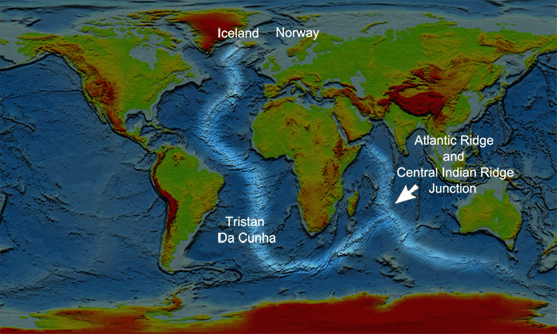
The Mid-Atlantic Ridge and the Secret Doctrine,  Antonios Goyios
 
Producing lost civilisations: Theosophical concepts, Handbook of New Religions & Cultural Production, 2012

Recent scientific articles:
 
A New Understanding of the Mid-Atlantic Ridge and Plate Tectonics 
Jackie Rocheleau 8 March, 2021 
The first seismic data obtained directly from the Mid-Atlantic Ridge suggest that upwelling may contribute to seafloor spreading.

Lost Continents Could Be Hidden Inside Earth 
Theo Nicitopoulos Jun 16, 2022
The discovery of ancient rocks at a mid-ocean ridge suggests that if there are lost continents, remnants might still be there.

Articles on Ignatius Donnelly:

Ignatius Donnelly: Paranoid progressive in the Gilded Age 
Atlantis Zac Farber Minnesota Lawyer May 30, 2018
gave a newspaper he founded the motto: “Eternal hostility to every form of oppression of the bodies & souls of men.”
 
Doctor Huguet: Ignatius Donnelly on Being Black 
John R. Bovee Minnesota History Summer 1969 286-94 
'In almost all his books, and certainly in his novels, he stressed above all that men must live as brothers' 'In every intelligent white man the intelligent black man will find a defender; and the reign of peace and love and brotherhood will begin.' collections.mnhs.org/MNHistoryMagaz


Ignatius Donnelly His Doctor Huguet novel 1891
JS Patterson American Quarterly 22, 4 1970  

update: first major modern study on Ignatius Donnelly, 2024
Zachary Michael Jack, The Strange Genius of Ignatius Donnelly: The Populist Who Debunked Shakespeare and Found Atlantis.  
 
The Peculiar Case of Ignatius Donnelly
Andrew Katzenstein December 12, 2024
https://www.thenation.com/article/culture/ignatius-donnellys-biography-review/


Tuesday, 7 June 2022

Blavatsky on the History of Early Christianity and Gnosticism

Isis Unveiled, Vol. 2,  Chapter 3

Overview of Early Gnosticism in Relation to Nazarene Groups (Divisions Among the Early Christians)

This chapter gives quite an intricate study of the origins of early Christianity from the perspective of comparative religion. Relying on some of the very learned and critical studies of the period, she adroitly follows the intricacies of the mystical movements from a period where there was really not a lot of historical records. What emerges is an interesting alternative portrayal of Jesus and Gnosticism, and so opens a theme that will be further pursued in most subsequent chapters. What is interesting is that, despite that focus on esoteric tradition, her views are quite realistic and modest, merely hinting at certain possibilities, based on historical research. Her emphasis on the term 'Nazarene' is quite distinctive and original, as their is little historical testimony related to this term. The subsequent discoveries of the Qmran and Nag Hammadi mystical texts tend to corroborate her ideas.

1- Peter and the Myth of Apostolic Succession (p.123)

Christianity sprung from perennial tradition 123/ Peter and the Dogma of Apostolic Succession 125 / Apocryphal Tradition about Peter and the Church 125 / Peter Apostle of Circumcision 126 / Sepher Toldos Jeshu 127

Clement describes Basilides, the Gnostic, as “a philosopher devoted to the contemplation of divine things.” This very appropriate expression may be applied to many of the founders of the more important sects which later were all engulfed in one — that stupendous compound of unintelligible dogmas enforced by Irenaeus, Tertullian, and others, which is now termed Christianity. If these must be called heresies, then early Christianity itself must be included in the number. Basilides and Valentinus preceded Irenaeus and Tertullian; and the two latter Fathers had less facts than the two former Gnostics to show that their heresy was plausible. Neither divine right nor truth brought about the triumph of their Christianity; fate alone was propitious. We can assert, with entire plausibility, that there is not one of all these sects — Kabalism, Judaism, and our present Christianity included — but sprung from the two main branches of that one mother-trunk, the once universal religion, which antedated the Vedaic ages — we speak of that prehistoric Buddhism which merged later into Brahmanism. (123)

We must once more return to that greatest of all the Patristic frauds; the one which has undeniably helped the Roman Catholic Church to its unmerited supremacy, viz.: the barefaced assertion, in the teeth of historical evidence, that Peter suffered martyrdom at Rome. It is but too natural that the Latin clergy should cling to it, for, with the exposure of the fraudulent nature of this pretext, the dogma of apostolic succession must fall to the ground. (125)

2- Nazarenes in Relation to Ebionites and Essenes (127)

Nazarenes and Ebionites 127

We may the more readily credit this friendship between Peter and his late co-religionists as we find in Theodoret the following assertion: “The Nazarenes are Jews, honoring the ANOINTED (Jesus) as a just man and using the Evangel according to Peter.”** Peter was a Nazarene, according to the Talmud. He belonged to the sect of the later Nazarenes, which dissented from the followers of John the Baptist, and became a rival sect; and which — as tradition goes — was instituted by Jesus himself.

History finds the first Christian sects to have been either Nazarenes like John the Baptist; or Ebionites, among whom were many of the relatives of Jesus; or Essenes (Iessaens) the Therapeutae, healers, of which the Nazaria were a branch. All these sects, which only in the days of Irenaeus began to be considered heretical, were more or less kabalistic. They believed in the expulsion of demons by magical incantations, and practiced this method; Jervis terms the Nabatheans and other such sects “wandering Jewish exorcists,”*** the Arabic word Nabae, meaning to wander, and the Hebrew [[Heb char]] naba, to prophesy. The Talmud indiscriminately calls all the Christians Nozari.* All the Gnostic sects equally believed in magic. Irenaeus, in describing the followers of Basilides, says, “They use images, invocations, incantations, and all other things pertaining unto magic.” Dunlap, on the authority of Lightfoot, shows that Jesus was called Nazaraios, in reference to his humble and mean external condition; “for Nazaraios means separation, alienation from other men.”** (127)

3- Jehovistic and Chaldean currents in Judaism (128)

Exoteric and Esoteric Religion in the Old Testament 128

The Jewish Scriptures indicate two distinct worships and religions among the Israelites; that of Bacchus-worship under the mask of Jehovah, and that of the Chaldean initiates to whom belonged some of the nazars, the theurgists, and a few of the prophets. The headquarters of these were always at Babylon and Chaldea, where two rival schools of Magians can be distinctly shown. Those who would doubt the statement will have in such a case to account for the discrepancy between history and Plato, who of all men of his day was certainly one of the best informed. Speaking of the Magians, he shows them as instructing the Persian kings of Zoroaster, as the son or priest of Oromasdes; and yet Darius, in the inscription at Bihistun, boasts of having restored the cultus of Ormazd and put down the Magian rites! Evidently there were two distinct and antagonistic Magian schools. The oldest and the most esoteric of the two being that which, satisfied with its unassailable knowledge and secret power, was content to apparently relinquish her exoteric popularity, and concede her supremacy into the hands of the reforming Darius. The later Gnostics showed the same prudent policy by accommodating themselves in every country to the prevailing religious forms, still secretly adhering to their own essential doctrines. (128)

4- John the Baptist’s relation to Nazarenes (132)

John the Baptist and the Nazarenes 132 / Essenes 133 / Baptism 134 / Pharisees and Saducees 135 / The Ginza (Codex Nazareus 136)

The oldest Nazarenes, who were the descendants of the Scripture nazars, and whose last prominent leader was John the Baptist, although never very orthodox in the sight of the scribes and Pharisees of Jerusalem were, nevertheless, respected and left unmolested. Even Herod “feared the multitude” because they regarded John as a prophet (Matthew xiv. 5). But the followers of Jesus evidently adhered to a sect which became a still more exasperating thorn in their side. It appeared as a heresy within another heresy; for while the nazars of the olden times, the “Sons of the Prophets,” were Chaldean kabalists, the adepts of the new dissenting sect showed themselves reformers and innovators from the first. 

The great similitude traced by some critics between the rites and observances of the earliest Christians and those of the Essenes may be accounted for without the slightest difficulty. The Essenes, as we remarked just now, were the converts of Buddhist missionaries who had overrun Egypt, Greece, and even Judea at one time, since the reign of Asoka the zealous propagandist; and while it is evidently to the Essenes that belongs the honor of having had the Nazarene reformer, Jesus, as a pupil, still the latter is found disagreeing with his early teachers on several questions of formal observance. He cannot strictly be called an Essene, for reasons which we will indicate further on, neither was he a nazar, or Nazaria of the older sect. What Jesus was, may be found in the Codex Nazaraeus, in the unjust accusations of the Bardesanian Gnostics. (133)


5- Jesus’ relation to Nazarenes (137)

Hindu Baptism Ceremonies 137 / Nazars, Essenes, Galileans 138

The motive of Jesus was evidently like that of Gautama-Buddha, to benefit humanity at large by producing a religious reform which should give it a religion of pure ethics; the true knowledge of God and nature having remained until then solely in the hands of the esoteric sects, and their adepts. As Jesus used oil and the Essenes never used aught but pure water,* he cannot be called a strict Essene. On the other hand, the Essenes were also “set apart”; they were healers (assaya) and dwelt in the desert as all ascetics did. (133)

6- Zoroastrian connection to Nazarenes (140)

Nazars and Paganism 141 / Nazars and Zoroastrianism 142

If we carefully trace the terms nazar, and nazaret, throughout the best known works of ancient writers, we will meet them in connection with “Pagan” as well as Jewish adepts. Thus, Alexander Polyhistor says of Pythagoras that he was a disciple of the Assyrian Nazaret, whom some suppose to be Ezekiel. Diogenes Laertius states most positively that Pythagoras, after being initiated into all the Mysteries of the Greeks and barbarians, “went into Egypt and afterward visited the Chaldeans and Magi”; and Apuleius maintains that it was Zoroaster who instructed Pythagoras.

Were we to suggest that the Hebrew nazars, the railing prophets of the “Lord,” had been initiated into the so-called Pagan mysteries, and belonged (or at least a majority of them) to the same Lodge or circle of adepts as those who were considered idolaters; that their “circle of prophets” was but a collateral branch of a secret association, which we may well term “international,” what a visitation of Christian wrath would we not incur! And still, the case looks strangely suspicious. (141)

7- Essenes and Mystery Religions in relation to Nazarenes (143)

Luke, who was a physician, is designated in the Syriac texts as Asaia, the Essaian or Essene. Josephus and Philo Judaeus have sufficiently described this sect to leave no doubt in our mind that the Nazarene Reformer, after having received his education in their dwellings in the desert, and been duly initiated in the Mysteries, preferred the free and independent life of a wandering Nazaria, and so separated or inazarenized himself from them, thus becoming a travelling Therapeute, a Nazaria, a healer. Every Therapeute, before quitting his community, had to do the same. Both Jesus and St. John the Baptist preached the end of the Age;** which proves their knowledge of the secret computation of the priests and kabalists, who with the chiefs of the Essene communities alone had the secret of the duration of the cycles. The latter were kabalists and theurgists; “they had their mystic books, and predicted future events,” says Munk.*** (144)

8- Jesus and the Ancient Portrayal of Magicians (147)

All this points undeniably to the fact, that except a handful of self-styled Christians who subsequently won the day, all the civilized portion of the Pagans who knew of Jesus honored him as a philosopher, an adept whom they placed on the same level with Pythagoras and Apollonius. Whence such a veneration on their part for a man, were he simply, as represented by the Synoptics, a poor, unknown Jewish carpenter from Nazareth? As an incarnated God there is no single record of him on this earth capable of withstanding the critical examination of science; as one of the greatest reformers, an inveterate enemy of every theological dogmatism, a persecutor of bigotry, a teacher of one of the most sublime codes of ethics, Jesus is one of the grandest and most clearly-defined figures on the panorama of human history. His age may, with every day, be receding farther and farther back into the gloomy and hazy mists of the past; and his theology — based on human fancy and supported by untenable dogmas may, nay, must with every day lose more of its unmerited prestige; alone the grand figure of the philosopher and moral reformer instead of growing paler will become with every century more pronounced and more clearly defined. It will reign supreme and universal only on that day when the whole of humanity recognizes but one father — the UNKNOWN ONE above — and one brother — the whole of mankind below. (150)

9- Docetic Aspect of Jesus and Reincarnation (151)

While the kabalists called this mysterious and rare occurrence of the union of spirit with the mortal charge entrusted to its care, the “descent of the Angel Gabriel” (the latter being a kind of generic name for it), the Messenger of Life, and the angel Metatron; and while the Nazarenes termed the same Abel-Zivo,* the Delegatus sent by the Lord of Celsitude, it was universally known as the “Anointed Spirit.”

Thus it is the acceptation of this doctrine which caused the Gnostics to maintain that Jesus was a man overshadowed by the Christos or Messenger of Life, and that his despairing cry from the cross “Eloi, Eloi, Lama Sabachthani,” was wrung from him at the instant when he felt that this inspiring Presence had finally abandoned him, for — as some affirmed — his faith had also abandoned him when on the cross. (154)

10 – Basilides, Buddhism, the Mystic Christ (155)

Thus, Christos, as a unity, is but an abstraction: a general idea representing the collective aggregation of the numberless spirit-entities, which are the direct emanations of the infinite, invisible, incomprehensible FIRST CAUSE — the individual spirits of men, erroneously called the souls. They are the divine sons of God, of which some only overshadow mortal men — but this the majority — some remain forever planetary spirits, and some — the smaller and rare minority — unite themselves during life with some men. Such God-like beings as Gautama-Buddha, Jesus, Tissoo, Christna, and a few others had united themselves with their spirits permanently — hence, they became gods on earth. Others, such as Moses, Pythagoras, Apollonius, Plotinus, Confucius, Plato, Iamblichus, and some Christian saints, having at intervals been so united, have taken rank in history as demi-gods and leaders of mankind. When unburdened of their terrestrial tabernacles, their freed souls, henceforth united forever with their spirits, rejoin the whole shining host, which is bound together in one spiritual solidarity of thought and deed, and called “the anointed.” Hence, the meaning of the Gnostics, who, by saying that “Christos” suffered spiritually for humanity, implied that his Divine Spirit suffered mostly. (159)

11- Marcion (159)

Was Marcion so far wrong? Was it blasphemy, or was it intuition, divine inspiration in him to express that which every honest heart yearning for truth, more or less feels and acknowledges? If in his sincere desire to establish a purely spiritual religion, a universal faith based on unadulterated truth, he found it necessary to make of Christianity an entirely new and separate system from that of Judaism, did not Marcion have the very words of Christ for his authority? “No man putteth a piece of new cloth into an old garment . . . for the rent is made worse. . . . Neither do men put new wine into old bottles, else the bottles break, and the wine runneth out, and the bottles perish; but they put new wine into new bottles, and both are preserved.” In what particular does the jealous, wrathful, revengeful God of Israel resemble the unknown deity, the God of mercy preached by Jesus; — his Father who is in Heaven, and the Father of all humanity? (163)

12- Hinduism, Buddhism, and Bacchus worship compared to Christianity (163)

“Good master, what shall I do that I may have eternal life?” asks a man of Jesus. “Keep the commandments.” “Which?” “Thou shalt do no murder, Thou shalt not commit adultery, Thou shalt not steal, Thou shalt not bear false witness,”** is the answer.

“What shall I do to obtain possession of Bhodi? (knowledge of eternal truth)” asks a disciple of his Buddhist master. “What way is there to become an Upasaka?” “Keep the commandments.” “What are they?” “Thou shalt abstain all thy life from murder, theft, adultery, and lying,” answers the master.***

Identical injunctions are they not? Divine injunctions, the living up to which would purify and exalt humanity. But are they more divine when uttered through one mouth than another? If it is god-like to return good for evil, does the enunciation of the precept by a Nazarene give it any greater force than its enunciation by an Indian, or Thibetan philosopher? We see that the Golden Rule was not original with Jesus; that its birth-place was India. Do what we may, we cannot deny Sakya-Muni Buddha a less remote antiquity than several centuries before the birth of Jesus. In seeking a model for his system of ethics why should Jesus have gone to the foot of the Himalayas rather than to the foot of Sinai, but that the doctrines of Manu and Gautarna harmonized exactly with his own philosophy, while those of Jehovah were to him abhorrent and terrifying? The Hindus taught to return good for evil, but the Jehovistic command was: “An eye for an eye” and “a tooth for a tooth.” (164)

Prominent authors and works used in this chapter:

Louis Jacolliot (1837-1890), Histoire des Vierges. Les Peuples et les continents disparus (History of the Virgins. Vanished People and Continents) (1874)
La Bible dans l’Inde, ou la Vie de Iezeus Christna (The Bible in India or The life of Iezeus Christna) (1869)
Lydia Maria Child (1802 – 1880), The Progress of Religious Ideas Through Successive Ages
John Denison Baldwin (1809 –1883), Pre-Historic Nations; or, Inquiries Concerning Some of the Great Peoples and Civilizations of Antiquity (1869)
Stanislas Aignan Julien (1797 –1873), Histoire de la Vie de Hiouen-Thsang [History of the Life of Xuanzang] (1856). 

Buddhist Records of the Western World, by Hiuen Tsiang. 2 vols. (Vol 1, 2) Translated by Samuel Beal. London. 1884.
Jacques Joseph Champollion-Figeac (1778 –1867), Égypte Ancienne (1839)
Max Müller (1823 –1900), Lectures on the Origin and Growth of Religion as Illustrated by the Religions of India (1878) “Buddhist Pilgrims”
On the Vanity of Idols (Ante-Nicene Fathers, Vol. 5)
Schott’s essay on Buddhism in Upper Asia and China (1846) Über den Buddhismus in Hochasien und in China. Berlin 1844; Probably quoted from The Travels of Marco Polo by Marco Polo, translated by Henry Yule