Sunday, 19 June 2016

Astrology: Mutable Grand Cross, Summer Solstice Full Moon June 20, 2016


Astrology: Mutable Grand Cross, Summer Solstice Full Moon June 20, 2016

As the Spring equinoctial eclipse was remarkably powerful this year, so is the Summer Solstice, the second point on the annual cross, marking the first quarter of the astrological year. Just as it happened this past Christmas and the Winter Solstice, it coincides with the full moon, the first time in 70 years. Moreover, Mercury positions itself midway in Gemini to form a mutable grand cross along with the Saturn, Jupiter, Neptune T-Square.

The Sun enters Cancer and this sign, according to French mason Jean-Marie Ragon, the sign is named after this shellfish because, as the sun reaches its apex and seems to reverse its course after this point, similar to the backward travelling motion of the crab. (La messe et ses mystères, p. 376) The month of June comes from junior, signifying ‘young’ because the primitive Roman new year began with this month.(Ragon, La Messe, p. 376). The ancients generally celebrated this moment with a feast marked by games and fires of joy, a tradition taken up in Christian practice with St-John’s Day. (Ragon, La Messe, p. 377)

According to Ragon, “June 9th, the day which the sun enters this sign and evokes those ancient symbols of initiation where, under the name of Hermathena, connecting both sexes with the two characters of Mystai and Epoptai, that is the active Mercury and the Contemplative Minerva.”. He furthers add that the reason for the fire in the heat of summer is to evoke the burning of the earth in the myth of Phaethon . (Ragon, La Messe, p. 377)

Summer Full Moon Fire

With the Sun/Venus conjunction in Cancer, we have a romantic, passionate summer full moon, nicely creative and intuitive, although with the moon opposite in Capricorn, there is moodiness and sensitivity, especially with family and amorous relations. A key point is the recently retrograde Neptune (in Pisces) as the Venus/Neptune trine, discounting the long-standing Jupiter/Pluto trine and Pluto/Neptune sextile, is the only ‘easy’ aspect in this chart, in conjunction with Pallas, heightening the creative, intuitive atmosphere. The moon’s relatively close proximity to Pluto in the sky, I think, is an added ingredient favoring spiritual inspiration.
Combustible Pluto/Uranus Square
The longstanding Pluto/Uranus square, combining with a Mars/Uranus semi-square and a Saturn/Uranus sesquialter, makes for a highly volatile factor for deep societal change and revolution, signaled by abrupt, explosive incidents. Note that Ceres, the goddess of the mysteries, is in perfect conjunction with Uranus.
Blazing Mutable Saturn-Mercury/Jupiter-Neptune Grand Cross
In the remarkably poetic timing that punctuates the cosmic dance in the harmony of the spheres, we witness the Sun/Venus pair that formed a Grand Cross at and with the new Moon on June 4th move into the solsticial position only to be closely followed by Mercury, replacing its position to form a new Grand Cross. Many consider that the Saturn/Jupiter/Neptune T-Square to be the most significant aspect of 2016, in place since September 2105 and due to end by late July. Thus this configuration can be considered to be the final crisis point of a rather tense, trying configuration.
Comprised of two oppositions and four squares, grand crosses are considered to be powerful, dynamic and intense – as well as complicated and difficult. Managing these energies often give results that can be either very troubled or very successful. With Saturn, Neptune, Pluto and Mars (in Scorpio) all retrograde there is a certain energy of retardation and also revelations from the past, with the recent exact Saturn/Neptune square on June 17 bringing an extra sense of anxiety to the mix.
Mercury is in domicile in Gemini and so is very strong, but the risk of scattered, cloudy, deluded or rigid thinking strongly challenges Mercury’s acumen in the areas of communication, relationships, travel and finance. Interestingly, Mercury is within 3 degrees conjunct to Vesta and the Part of Fortune. There might be a tendency to be pessimistic and overly critical (Mercury/Saturn opposition) or hyperbolic (Mercury square Jupiter), although the Venus/Sun conjunction should bring some tolerant, cheerfull compassion.
I interpret the Mercury placement to signify that one can be faced with some intense decisions or meetings concerning important issues in a broad range of socio-political concerns. I would suggest to be careful of the rashness and impulsiveness that this passionate, high energy aspect encourages and therefore one would do well to be cautious and read the fine print before making decisions. Loose lips sink ships. At the same time, successful outcomes can be had by bold operators in a worthy cause, if they play their cards right; although in that case, I think flexibility and openness is important.
Although this long-standing Saturn/Jupiter/Neptune T-Square has been tense and difficult, it is possible that, by the end of the summer, one could witness a positive dissolution of constrictive obstacles, unrealistic objectives and unproductive commitments, paving the way for a new series of aspects forming near the upcoming fall equinox (Jupiter enters Libra) and winter solstice points (a Jupiter/Uranus/Pluto T-Square) that bring on some fresh challenges...


Friday, 17 June 2016

Introduction to the Epistemology of Proclus


The divided line, which forms the foundation of Platonic dialectic, is an important aspect of Proclean epistemology. For example, he uses this passage as a basis for his introduction to his Commentary of Euclid’s Elements and it therefore serves as a good introduction to his philosophy in general. To give a brief background of his rather complex form of Neoplatonism, one can characterize as an eminently holistic philosophy based on what could be termed a dynamic multi-modal hierarchical structure of reality. His opening to his Commentary on Plato’s Parmenides can serve as a brief overview of this philosophy:

I pray to all the gods and goddesses to guide my mind in this study that I have undertaken-to kindle in me a shining light of truth and enlarge my understanding for the genuine science of being; to open the gates of my soul to receive the inspired guidance of Plato; and in anchoring my thought in the full splendour of reality to hold me back from too much conceit of wisdom and from the paths of error by keeping me in intellectual converse with those realities from which alone the eye of the soul is refreshed and nourished, as Plato says in the Phaedrus. I ask from the intelligible gods, fullness and wisdom, from the intellectual gods, the power to rise aloft, from the supercelestial gods guiding the universe, activity free and unconcerned with material inquiries, from the gods to whom the cosmos is assigned, a winged life, from the angelic choruses, a true revelation of the divine, from the good daemons an abundant filling of divine inspiration, and from the heroes, a generous, solemn, and  lofty disposition. (618, 19)

Perhaps more than any other Neoplatonist, Proclus was interested in developing the educational program, often referred to as the quadrivium and trivium, which Plato introduced in the Republic. Therefore he was very much concerned with mathematics, geometry and astronomy. For example, he presents the following paraphrase of Plato’s divided line in his presentation of a general theory of science:
 
In the Republic he sets on one side the objects of knowledge and over against them the forms of knowing, and pairs the forms of knowing with the types of knowable things. Some things he posits as intelligibles (noeta) others as perceptibles (aistheta); and then makes a further distinction among intelligbles between intelligibles and understandables (dianoeta) and among perceptibles and likenesses (eikasta). To the intelligibles, the highest of the classes, he assigns intellection (noesis) as its mode of knowing, to understandables understanding (dianoia), to perceptibles belief (pistis), and to likenesses conjecture (eikasia). He shows that conjecture has the relation to perception that understanding has to intellection; for conjecture apprehends the images of sense objects in water or other reflecting surfaces, which, as they are really only images of images, occupy almost the lowest rank in the scale of kinds, while understanding studies the likenesses of intelligibles that have descended from their primary simple and indivisible forms into plurality and division. For this reason the knowledge that understanding has is dependent on other and prior hypotheses, whereas intellection attains to the unhypothetical principle itself. (11, 9)\

Moreover, in the two prologues to his Commentary on Euclid’s Elements, Proclus outlines a full epistemological program centered around the central books of Plato’s Republic in an eclectic synthesis of elements from Pythagorean, Platonic, Aristotelian, and  Stoic sources. Influenced by Pythagoreanism, he outlines a metaphysical system based on mathematical and geometric-based concepts, presented as binary and ternary concepts, the highest being the notions of the limit and unlimited (peiras, apeiron) (based on Plato’s Philebus 16cff and 23cff.): ‘’To find the principles of mathematical being as a whole, we must ascend to those all-pervading principles that generate everything from themselves: namely, the Limit and the Unlimited. For these, the two highest principles after the indescribable and utterly incomprehensible causation of the One, give rise to everything else, including mathematical beings’’(6). These principles determine the aspects of the divisible and indivisible, establishing a limit/indivisible, unlimited/divisible correspondence:

For this reason both in Nous and in the intermediate orders of souls-that is, those natures that directly breathe life into bodies- the limiting factors have an essential priority over the things that are limited, as being less divisible, more uniform, and more sovereign; for among immaterial forms unity is more perfect than plurality, the partless more perfect than what proceeds in and away from it, and what bounds more perfect that what gets its limit from something other than itself. (86)

The images of the straight line and the circle are further related to cosmological functions, the line being related to the soul and the circle to the intellect and are also related to the fundamental ontological Neo-platonic dynamic of procession, related to the line, and reversion, related to the circle: ‘‘the straight line makes clear the procession [πρόοδος] of psychical life from superior things, and the bending-back [κατάκαμψις] into a circle makes clear its intellectual turning [στροϕή]’.] (InTimaeum  [2.248,11–23; cp. 2.244,15–17]).

This leads to his theory of  the ontological status of mathematicals, which are situated at an intermediary between  the indivisible and the divisible, containing aspects of both. This theory forms the basis of his theory of projection. It is through the imagination that mathematical concepts rooted in the soul become articulated in human understanding, through a process of collection and division. The imagination transforms archetypal forms into concrete images. It is considered an intermediary faculty between understanding and sensation: ‘’To this difficulty we reply that the imagination in its activity is not divisible only, neither is it indivisible. Rather it moves from the undivided to the divided, from the unformed, to what is formed’’ (In Euclid 95).

Thursday, 9 June 2016

Proclus on Plato's Divided Line from Republic VII - (Part 2)

From Proclus: Commentary on Plato’s Republic Treatise XII – Part I
On the cave in the VIIth book of the Republic
The Divided Line, 287.20 – 290.30


(Theosophically, the passage below could be considered to deal with the Astral Plane)


For the greater section can be considered to represent the intelligible world, it being superior to and encompassing the other, the lesser, which represents the visible world. For it is encompassed by this (section) according to cause. The encompassed is everywhere lesser than the encompassing, taken to be encompassed either by essence or according to actuality or according to potentiality,[4] just as can be seen with all of the continuous and the divided. [5]  Therefore, of the original unequal (sections) of the line, the greater is the genus of the intelligible world, and the other, the lesser, the genus of the visible world. And he related this,beginning with the genus of the visible, so that it is recognized first.

The other section of this division natures is comprised of  images, and all the rest exist according to the images. From the activity of the images, moreover, which signify sculptures and paintings and everything of that nature, he divides the things to be emanated from the images, like the enlightened things are produced by the enlighteners,[6] calling these images shadows and reflections in the water and other mirrors. And when defining what is needed to go into the body of the mirrors, he specifies denseness, smoothness and brightness.  For denseness is needed so that the reflection that falls upon the pores is not lost in the many formations of the emanations of the forms. Therefore all the images of the visible have a specific nature and, in a certain manner, essence by virtue of the forms that they manifest as.[7] As for the smoothness, so that the roughness by the nooks and crannies is not a cause of unevenness in the coming to be of the formation. Of the brightness, so that the image, the nature of which brings obscurity to the form, is nevertheless visible. For like the particles that are seen floating through a ray of light through a window, they are invisible without light, their own composition making them invisible.

Now from these considerations of ours, and according to Plato, the reflections will be some kind of manifested image of an essence produced by divine artifice, just as he teaches in the Sophist. As for the shadows, of which the images are the form, he said, they have this nature. And as for material things, they will be both images of shapes, and have very much sympathy with the things from which they are descended.[8] And this is shown to us by accounts of the arts of the magicians which have reached us concerning shades and phantoms.[9] And what to say of the activity of the shades? Actually, the idea can already be seen with irrational animals, before any other account.  For the hyena, they say, when treading on the shadow of a dog sitting on high, the dog is stricken down and so the dog is make into a meal.[10] And when a woman being cleansed (menstruating), says Aristotle (On Dreams 459b27), looks in a mirror, the mirror and the reflected image become blood-red.[11] So the shades are also substantial realities, according to Plato, and the gist of the analogy is clear. For he says that the images have the same relation to the visible, as the intellectual has to the intelligible, therefore these images have some kind of form and real being.

 [4]   Ousia, energeia, and dunamis are terms derived from Aristotle’s Physics, of course here having a more Neoplatonic meaning.
[5]           Sunekes, continuous, is a geometric term used in Aristotle’s Physics.  Proclus tends to equate this with the concept of indivisibility. According to Opsomer: This inference presupposes that every unmoved thing is indivisible. However, this hidden premise is not warranted by the previous arguments. Proclus has so far merely argued that everything indivisible is unmoved, not the other way around. Proclus tacitly introduces the equations: the incorporeal = the indivisible = the unmoved; the corporeal = the divisible = the moved” (195).
[6]              Here he is making reference to the image of the shadows projected on the walls, in the Myth of the Cave from Republic, book VII.
[7]              A rather free rendering, based on Kroll (290 n. 27).
[8]              I take this somewhat cryptic passage to describe how things manifest themselves by an emanation from a pure archetype in the intelligible, then taking a kind of ethereal form in the world of psyche, which is an intermediate order between the ideal realm and the material world before manifesting in embodied physical form.
[9]              I take this to refer to practices of summoning various departed souls and spiritual beings of some sort or causing apparitions.
[10]             A similar account can be found in Aelian h.a. VI 14 (Kroll 290).
[11]          A similar account can be found in Pliny VIII 106 (Kroll 290).

Friday, 3 June 2016

Proclus on Plato's Divided Line from Republic VII - (Part I)

From Proclus: Commentary on Plato’s Republic Treatise XII – Part I
On the cave in the VIIth book of the Republic
The Divided Line, 287.20 – 290.30
If it is also required for us to talk about the cave and of everything outside of the cave and of their resemblance to Real Things (ta pragamata), let if first be said how he divides (the All) into sections of the line. Because he also compares the things in the cave to the objects of opinion and the things outside of the cave to objects of knowledge. And by having completed the division of this in book VI, he shaped this image at the beginning of book VII. And he took up again by images of the division, elaborating the divisions of knowledge and that to which knowledge applies, as he himself said.

Between these two (accounts) he somewhere posits in this comparison, following that which has been determined before, that there are four sections of the all. Let us take these things up then in a few words, by which we should see how the whole image is in agreement.

Since he wants to show that the procession of being from the one is continuous and unified, he compares this continuous series of things to a single line, with the second order always proceeding in likeness and coherence from the first order, with no part being separated by a void. For this was not lawful, as the good brings forth everything and reverts them back to itself.

There needs to be a resemblance of the creation to the creator. This (creator) being one, it is therefore necessary for creation to be continuous, for the continuous is similar to the one and the cause of this continuity is the similarity of the following sections to the first and everyone agrees that this (similarity) comes from the One. For what similar is derived from the nature of the One.[1] He therefore takes a single line, and he cuts it in two, not in equal parts of the section, but in unequal, yet in two nevertheless. For in the Philebus, for those who contemplate true being, it is advised to contemplate after the One, the Two, if it is at all, and if not, the number closest to the Dyad. And so the unequal cut of the All shows the value of the division to him, setting the inequality according to the continuous as an image of the inequality of the substance. And of this analogy of the two unequal sections that he cuts from the original line, he distinctly signifies again an analogy of identity with the second, subservient to the first.[2]

For the analogy is an identity of reason, “the most beautiful of bonds”, as we have understood in the Timaeus (31 c2), and a “judgment of God” as we have heard in the Laws (VI 751 b6).
Moreover, as the cosmos was created according to analogy, all things are then held together by a permanent friendship, and in this way the All proceeded, joining all things together and harmonizing them and as the four sections of the single line are introduced by him, he assumes that the first two make up the greater part, being the genus of the intelligible world (noumenon),[3] and the lesser being the genus of the visible world.

[1]              The One being the Neoplatonic absolute transcending ultimate principle. It is actually the demiurge that is considered to be responsible for the creation of the material universe, but the One is considered the creator because ultimately all planes of reality are emanated from it.
[2]              This passage deals with Pythagorean metaphysics, see my introduction and the related fn. 11.
[3]              To translate certain Neoplatonic ontological concepts, which in the Greek have the form of single nouns in the genitive case or participles, I variously add the term “world” or “order” to convey the meaning.

Part 2 

Friday, 27 May 2016

Theosophy Basics: Gupta Vidya, Atma Vidya, Brahma Vidya


Blavatsky gives a number of terms to designate Theosophy, including some oriental equivalents. One she gives is Gupta Vidya as per the following eloquent, poetic description:
The great science, called by the vulgar “magic,” and by its Eastern proficients Gupta-Vidya, embracing as it does each and every science, since it is the acme of knowledge, and constitutes the perfection of philosophy, is universal; hence—as very truly remarked cannot be confined to one particular nation or geographical locality.
But, as Truth is one, the method for the attainment of its highest proficiency must necessarily be also one. It cannot be subdivided, for, once reduced to parts, each of them, left to itself, will, like rays of light, diverge from, instead of converging to, its centre, the ultimate goal of knowledge; and these parts can re-become the Whole only by collecting them together again, or each fraction will remain but a fraction.
He is at one and the same time a Chaldaean Sage, a Persian Magi, a Greek Theurgist, an Egyptian Hermetist, a Buddhist Rahat, and an Indian Yogi. He has collected into one bundle all the separate fractions of Truth widely scattered over the nations, and holds in his hands the One Truth, a torch of light which no adverse wind can bend, blow out or even cause to waver. Not he the Prometheus who robs but a portion of the Sacred Fire, and therefore finds himself chained to Mount Caucasus for his intestines to be devoured by vultures, for he has secured God within himself, and depends no more on the whim and caprice of either or evil deities.”
(HPB CW 3, 266-68 - MADAME BLAVATSKY ON “THE HIMALAYAN BROTHERS” [The Spiritualist, London, August, 12, 1881])
Gupta means secret, Vidya means knowledge.  A similar term is guhya-vidya [ guhyavidyA ] meaning knowledge of Mantras or mystical incantations. (see Vishnu Purana. i, 9, 117; see also the Theosophical Glossary). Chapter 9 of the Gita  is titled Raja-Vidhya Yoga or the Raja-Guhya Vidhya. Etymologically, the term Vidya gives the Greek verb, to know, and in English, wisdom (Monier Williams, Sanskrit Lexicon):
Elsewhere she outlines four types of Gupta-Vidya: “There are four (out of the many other) names of the various kinds of Esoteric Knowledge or Sciences given, even in the esoteric Purânas. There is
(1) Yajna-Vidya,1 knowledge of the occult powers awakened in Nature by the performance of certain religious ceremonies
(2) Maha-vidya, the "great knowledge," the magic of the Kabalists and of the Tantrika worship, often Sorcery of the worst description.
(3) Guhya-Vidya, knowledge of the mystic powers residing in Sound (Ether), hence in the Mantras (chanted prayers or incantations) and depending on the rhythm and melody used; in other words a magical performance based on Knowledge of the Forces of Nature and their correlation; and
(4) ATMA-VIDYA, a term which is translated simply "knowledge of the Soul," true Wisdom by the Orientalists, but which means far more.
This last is the only kind of Occultism that any theosophist who admires Light on the Path, and who would be wise and unselfish, ought to strive after.”(Occultism versus the Occult Arts, Lucifer, May, 1888)
Another term she uses is Brahma Vidya ((Mahabharata V. 30: “This weapon of Brahma is the science of Brahma or of the Veda. This choice of a boon  seeks the removal of all obstacles  to the attainment of divine knowledge.” See also the Brahmavidyā Upanishad): “Theosophy is the equivalent of Brahm-Vidya, divine knowledge” (Key, sect. 1 fn 1). A more expanded explanation is given elsewhere:

“Theosophy is synonymous with the Jnana-Vidya, and with the Brahma-Vidya (1) of the Hindus, and again with the Dzyan of the trans-Himalayan adepts, the science of the true Raj-Yogis, who are much more accessible than one thinks. This science has many schools in the East. But its offshoots are still more numerous, each one having ended by separating itself from the parent stem — the true Archaic Wisdom — and changing its form. (THE BEACON OF THE UNKNOWN La Revue Théosophique, Paris, Vol. I, Nos. 3,4,5,6; May 21 , 1889, pp. 1-9; June 21, 1889; pp. 1-7; July 21, 1889, pp. 1-6; August 21, 1889, pp. 1-9] CW 11, p.256
Blavatsky tends to relate Theosophy as a western term to Neoplatonism, and there is an early Neoplatonic text that relates the term Theosophy to Indian sources, Porphyry’s lengthy treatise On the Abstinence from Animal Foods
“In the land of Hindus, divided in many ethnicities exists the ilk of theosophos, and the Greeks are accustomed referring to them as gymnosophists ["naked philosophers”]. There are two sects of gymnosophists, one is headed by the Brahmans the others by the Shramana[5] (śramana). While Brahmans maintain the hereditary succession of Theosophia [Theosophy] - exactly as happens with priesthood - the Shramana comprises a social category composed by those who want to practice Theosophia [Theosophy].” [6] («Περí Αποχής Εμψύχων» 17, π 237, β. 4)

picture thanks to http://my.yoga-vidya.org/

Sunday, 22 May 2016

Book Review: Grandma’s Lifesaving Tips – Susie Foster – SJG pubs. 2014


For those aspirants seeking initiation into the mysteries of household management, this book will reveal plenty of the arcane secrets thereof. In today’s attention deficit, instant gratification, high-tech, ultra-processed, automated, asceptic world, what use is this simple, quaint old-fashioned collection of traditional household maintenance methods and tips? You’ll be surprised at how timeless and relevant these old bits of practical wisdom can be.
1- Organizing the Chaos
The first chapter and possible the most important concerns organization and many creative and inventive selections are proposed to control the clutter and keeps things running smoothly.
2- Wardrobe Rescue
Of course clothes care is essential and all aspects of the tricky business of clothing maintenance, storage, cleaning and repair are covered.
3- High Days & Holidays
Holidays and parties add such zest and gaiety to one’s home life and this chapter shows how to save time and money without sacrificing the fun.
4- Kitchen Calm
Of course the kitchen, often considered the very heart of the home, is given the caring consideration it so richly deserves; and the variety of long-term food preparation methods is most impressive indeed.
5- Housework SOS
The difficult problem of housecleaning is tackled with uncompromising frankness and it is amazing how many low-cost, natural cleaning solutions there are. The versatility of vinegar is shown to be mind-blogging.
6- Household Purse
Of course budgeting finances is key and Grandma shares very helpful and shrewd ways to cut costs and stretch the dollar.
7- Getting to Grips with the Garden
Gardening is given a high priority in the household activities, (and rightly so) and the author gives experienced advice.
8- Sprucing up the House
The esthetic aspect is not neglected; this fun chapter on decorating is both practical and creative.
9- Reusing & Recycling
Nowadays we talk about the need to implement more ecological practices; but back in the day, respect for the environment was a fully integrated part of the program.  The possibilities for thrift are a key focus and this chapter on recycling contains deeply ecological, environment-saving advice.
10 You & Yours
With all the hustle and bustle of home management, personal care should not be neglected and so the final chapter has a wonderful array of surprisingly simple recipes to relax, refresh, soothe and regenerate the body and soul.
Household management is key for a well-balanced life and the wealth of information and wisdom in this book gives one some solid tools for building a quality home life. Kudos to seagulls.net for an elegant retro design.


Monday, 25 April 2016

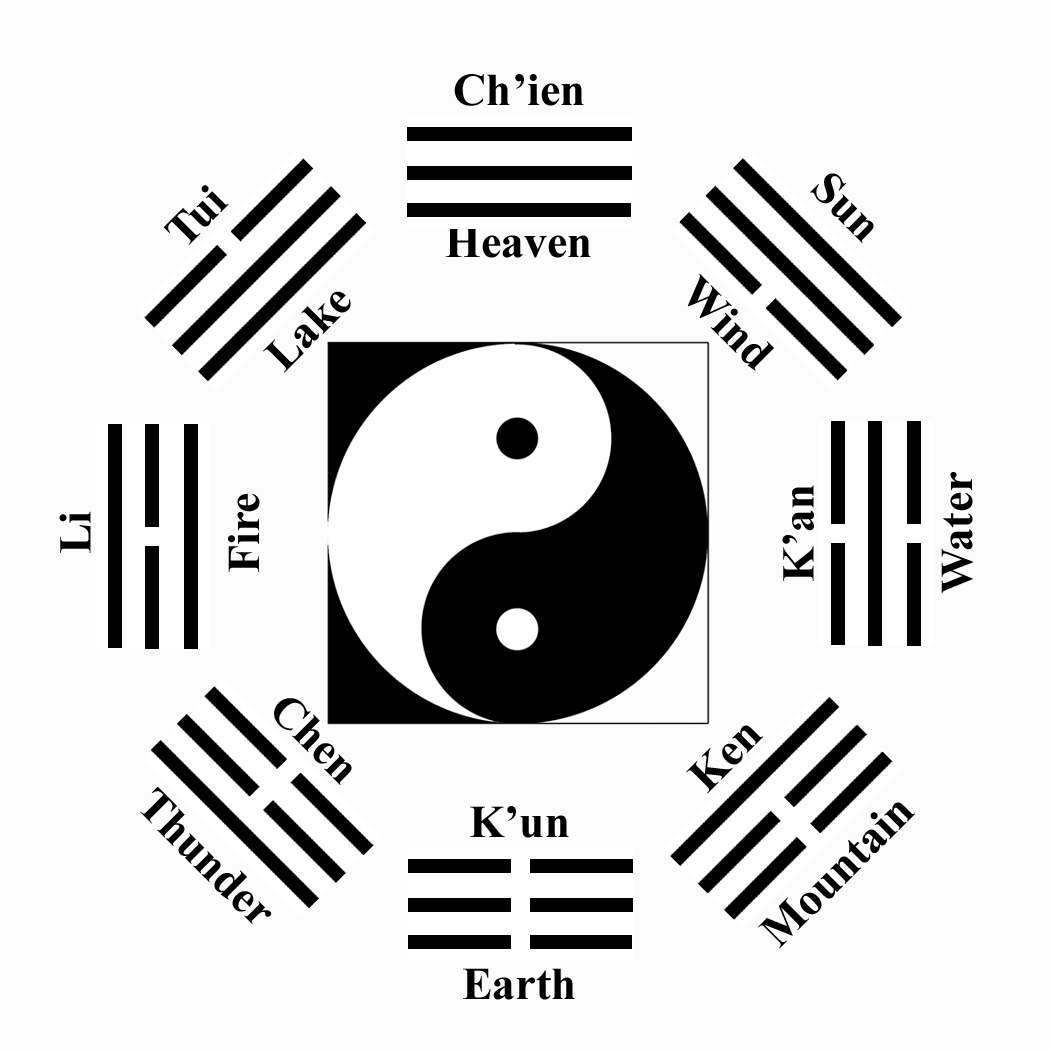
Blavatsky on the I-Ching or Book of Changes

"The Yi-King, “the very essence of ancient thought and the combined work of the most venerated sages, fails to show a distinct cosmogony.” Nevertheless, there is one, and a very distinct one. Only as Confucius did not admit of a future life† and the Chinese Buddhists reject the idea of One Creator, accepting one cause and its numberless effects, they are misunderstood by the believers in a personal God.
The “great Extreme” as the commencement “of changes” (transmigrations) is the shortest and perhaps the most suggestive of all Cosmogonies, for those who, like the Confucianists, love virtue for its own sake, and try to do good unselfishly without perpetually looking to reward and profit.
The “great Extreme” of Confucius produces “two figures.” These “two” produce in their turn “the four images”; these again “the eight symbols.” It is complained that though the Confucianists see in them “Heaven, Earth and man in miniature,” . . . we can see in them anything we like. No doubt, and so it is with regard to many symbols, especially in those of the latest religions. But they who know something of Occult numerals, see in these “figures” the symbol, however rude, of a harmonious progressive Evolution of Kosmos and its beings, both the Heavenly and the Terrestrial. And any one who has studied the numerical evolution in the primeval cosmogony of Pythagoras (a contemporary of Confucius) can never fail to find in his Triad, Tetractis and Decade emerging from the one and solitary Monad, the same idea. Confucius is laughed at by his Christian biographer for “talking of divination” before and after this passage, and is represented as saying: “The eight symbols determine good and ill fortune, and these lead to great deeds. There are no imitable images greater than heaven and earth. There are no changes greater than the four seasons (meaning North, South, East and West, et seq.). There are no suspended images brighter than the sun and moon. In preparing things for use, there is none greater than the sage. In determining good and ill-luck there is nothing greater than the divining straws and the tortoise.”*

Therefore, the “divining straws” and the “tortoise,” the “symbolic sets of lines,” and the great sage who looks at them as they become one and two, and two become four, and four become eight, and the other sets “three and six,” are laughed to scorn, only because his wise symbols are misunderstood.

† If he rejected it, it was on the ground of what he calls the changes — in other words, rebirths — of man, and constant transformations. He denied immortality to the personality of man — as we do — not to man." (The Secret Doctrine I, p. 440-41)