As we approach the Summer Solstice, following the Jupiter square Pluto, May 17, we cap off a very eventful Spring semester with Jupiter sextile Saturn, June 19.
With the intense Pluto T-square fading, there was a terrible India train crash and widespread forest fires in Canada. The intensity
continues with a volatile Mars square Uranus, exact June 26 .
Jupiter, at 7° Taurus 13′, forms a sextile with
Saturn, at 7° Pisces 13′ on June 19, 2023. This is a one-off transit (it
doesn’t repeat two more times over the course of many months as many
outer-planet transits do).
With Jupiter forming a sextile to Saturn,
opportunities to put our plans into motion arise. We’re balanced in our
approach to new endeavors, seeing both the potential benefits and pitfalls, and
this improves our judgment. This influence helps to crystallize and lock down
lessons learned and endeavors begun recently.
This is a period of constructive accomplishment. We
are practical, realistic, and our judgment is especially sound–and we derive
much satisfaction from practical accomplishment. We find a good balance between
planning and discovering.
It’s also a time when we value learning and valid
information from trustworthy sources. We respect reasonable, ethical, and sound
approaches.The key to harnessing this wonderful energy is to identify
and find pleasure in the simple things that make us happy.
Fun Facts:
The last time Jupiter formed a sextile to Saturn was
in 2017. However, the last time Jupiter formed an upper sextile to
Saturn like this Jupiter-Saturn sextile was from November 2003 to August 2004
when Jupiter was in Virgo and Saturn was in Cancer.
Jupiter sextile Saturn transit is a time of cautious
expansion. Some growth opportunities are likely to be offered, and you can rely
on sound judgment skills to choose only those right for you. These
opportunities may be in your career, through investment or business deals, or
in your personal life as significant material possessions or relationship
choices.
Patience, perseverance, and a strong work ethic mean
you are most likely to succeed now. Common sense and sustained effort are
required because this is a serious and long-term project you are working on. It
may not be an exciting phase of life, but you will gain great satisfaction and
contentment. The results of your achievements will still be enjoyed long after
this transit has passed.
You may earn a promotion or take on more
responsibility, and you will come out of this experience wiser, wealthier, or
happier. Business investments will bring you financial stability and long-term
steady growth. Investing in property or blue-chip stocks would be especially
good for wealth creation. This is an excellent time to start a savings plan,
buy a house, or create a small business.
H.P.
Blavatsky describes Taurus as a ‘most mysterious constellation of the Zodiac,
one connected with all the “First-born” solar gods. The Bull is the symbol of
force and procreative power—the Logos’ (Blavatsky ‘Taurus’, Theosophical
Glossary). Moreover, the ‘worship of the Bull and the Ram was addressed to one
and the same power, that of generative creation, under two aspects— the
celestial or cosmic, and the terrestrial or human. The ram-headed gods all
belong to the latter aspect, the bull—to the former. the emblems of the
generative, or of evolutionary power in the Universal Kosmos’ (Blavatsky,
Bull-Worship,Theosophical
Glossary).
She gives a general overview
of the Bull symbol in different traditions: ‘The bull Nardi, the vehan
of Siva and the most sacred emblem of this god, is reproduced in the Egyptian
Apis; and in the bull created by Ormazd and killed by Ahriman. The religion of
Zoroaster, all based upon the "secret doctrine," is found held by the
people of Eritene; it was the religion of the Persians when they conquered the
Assyrians. From thence it is easy to trace the introduction of this emblem of LIFE represented by the Bull, in every
religious system. The college of the Magians had accepted it with the change of
dynasty; Daniel is described as a Rabbi, the chief of the Babylonian
astrologers and Magi (Book of Daniel, iv,v); therefore we see
the Assyrian little bulls and the attributes of Siva reappearing under a hardly
modified form in the cherubs of the Talmudistic Jews, as we have traced the
bull Apis in the sphinxes or cherubs of the Mosaic Ark; and as we find it
several thousand years later in the company of one of the Christian evangelists
Luke’ (Isis Unveiled 2, 235-6).
1-Nandi [Bull] 2nd c. AD Mysore
Nandi is the bull vahana of the Hindu
god Shiva. He is
also the guardian deity of Kailash, the abode of Shiva. Almost all Shiva temples
display stone-images of a seated Nandi, generally facing the main shrine.
According to SaivaSiddhanta, Nandeeswarar is considered to be chief
among the Siddhars,
initiated by Mother Parvati and Father Shiva. He passed on
what he had learned to his 8 disciples, namely, the Four
Kumaras, Sundaranandar
who later becomes Tirumular by a chance happening, Vyagrapada
(also known as Pullipani), Patanjali, and Sivayoga Muni. They were sent out in eight
different directions, to spread wisdom (Gopinatha Rao, T. A. (1997). Elements of Hindu Iconography, Volume 2. Motilal Banarsidass Publishers. p. 213). Subba Row gives an
esoteric account of the Hindu astrological symbol:Rishabha. This
word is used in several places in the Upanishats and the Veda to mean Pranava
(Aum). Shankarâchârya has so interpreted it in several portions of his
commentary. [Example: Rishabhasya – Chhandasam
Rishabhasya Pradhânasya Pranavasya]
2- Nandi, zoo-anthropomorphic form
For the Egyptian symbolism,
Blavatsky gives a rather specific instance of the god Apis: “It is not simple
chance,” we are told, “that has placed in certain spheres, on a throne, the
head of that bull (Taurus), trying to push away with the ansated
cross on its horns, a Dragon; the more so, since this constellation
of Taurus was called ‘the great city of God and the mother of
revelations,’ and also ‘the interpreter of the divine voice,’ the Apis
pacis of Hermoutis, in Egypt, which (as the patristic fathers would
assure the world) preferred oracles that related to the birth of the Saviour” (Pneumatologie,
iv., 71) …The serpent was the symbol of
Wisdom; and the Bull (Taurus)
the symbol of physical or terrestrial generation. Thus the latter,
pushing off the Dragon, or spiritual, Divine Wisdom, with the Tau,
or Cross — which is esoterically “the foundation and framework of all
construction” (Secret Doctrine 1, 657) . Moreover, the 'black bull Mnevis, the son of Ptah, was sacred to the God Ra at Heliopolis; the Pacis of
Hermonthis—to Amoun Horus, &c., &c., and Apis himself was a
hermaphodite and not a male animal, which shows his cosmic character' (Blavatsky,
Bull-Worship,Theosophical
Glossary).
3- Apis, Bull with moon, 1823-25
Regarding Apis in the form a bull, this animal was
chosen because it symbolized the courageous heart, great strength, and fighting
spirit of the king. Apis came to being considered a manifestation of the king,
as bulls were symbols of strength and fertility, qualities that are closely
linked with kingship. "Strong bull of his mother Hathor" was a
common title for Egyptian gods and male kings, being unused for women serving
as king, such as Hatshepsut.
As early as the time of the Narmer
Palette, the king is depicted with a bovine tail on one side, and a bull is
seen knocking down the walls of a city on the other. Occasionally, Apis was pictured with the
sun-disk symbol of his mother, Hathor, between his horns, being one of few
deities ever associated with her symbol. When the disk was depicted on his head
with his horns below and the triangular marking on his forehead, an ankh was suggested.
That symbol always was closely associated with Hathor.
4-Apis statue
Early on, Apis was the herald (wḥm)
of Ptah, the chief
deity in the area around Memphis. As a manifestation of Ptah, Apis also was
considered to be a symbol of the king, embodying the qualities of kingship. In
the region where Ptah was worshiped, cattle exhibited white patterning on their
mainly black bodies, and so a belief grew up that the Apis calf had to have a
certain set of markings suitable to its role. It was required to have a white triangular
marking upon its forehead, a white Egyptian vulture wing outline on its back, a
scarab mark under its tongue, a white crescent moon shape on its right flank,
and double hairs on his tail.
The calf that matched these markings was selected from
the herds, brought to a temple, given a harem of cows, and worshiped as an
aspect of Ptah. The cow who was his mother was believed to have conceived him by
a flash of lightning from the heavens, or from moonbeams. She also was treated
specially, and given a special burial. At the temple, Apis was used as an oracle,
his movements being interpreted as prophecies. His breath was believed to cure
disease and his presence to bless those around with strength. A window was
created in the temple through which he could be viewed and, on certain
holidays, he was led through the streets of the city, bedecked with jewelry and
flowers (Griffith, Francis Llewellyn (1911). "Apis". In Chisholm, Hugh (ed.). Encyclopædia Britannica. Vol. 2 (11th ed.). Cambridge University Press. p. 168).
Blavatsky also points out the
story of the bull in the Zoroastrian Avesta:
Kain, presiding over the Taurus
(Bull) of the Zodiac, is also very suggestive. Taurus belongs to the earthy
trigon, and in connection with this sign it will not be amiss to remind the
student of an allegory from the Persian Avesta. The story goes that
Ormazd produced a being — source and type of all the universal beings — called LIFE, or Bull in the Zend.
Ahriman (Cain) kills this being (Abel), from the seed of which (Seth) new
beings are produced. (Isis
Unveiled 2, 465).
6- Gozu Tenno
The Bundahishn of the Middle Persian era tells of the
world created by the deity Ahura Mazda. The great mountain, Alburz, grew for
800 years until it touched the sky. From that point, rain fell, forming the Vourukasha
sea and two great rivers. The first animal, the white bull, lived on the bank of the
river Veh Rod. Gavaevodata is the Avestan language name of the primordial bovine of Zoroastrian cosmogony and cosmology, one of Ahura Mazda's six primordial material creations and the mythological progenitor of all beneficent animal life.
However, the evil spirit, Angra Mainyu, killed it. Its seed was
carried to the moon and purified, creating many animals and plants (Boyce, Mary (1975), A History of Zoroastrianism, vol. 1, Leiden: Brill, pp. 138–139)
Jean-Marie
Ragon relates how the bull in Japanese myths relates to this sign (La Messe et ses Mysteres, 1844, p. 347).With the fusion of Shinto and Buddhism, Susa-no-O was identified with GozuTenno ("Bull-headed King of Heaven").
ENQUIRER. But "M. A. Oxon" (pen-name of William Stainton Moses) is a
Spiritualist?
THEOSOPHIST. Quite so, and the only true Spiritualist
I know of, though we may still disagree with him on many a minor question.
Apart from this, no Spiritualist comes nearer to the occult truths than he
does.
Nothing is more dangerous than for souls to be rudely
severed from their bodily habitation, and to be launched into spirit-life, with
angry passions stirred, and revengeful feelings dominant. It is bad that any
should be dismissed from earth-life suddenly, and before the bond is naturally
severed. It is for this reason that all destruction of bodily flesh is foolish
and rude: rude, as betokening a barbarous ignorance of the conditions of life
and progress hereafter; foolish, as releasing an undeveloped angry spirit from
its trammels, and enduing it with extended capacity for mischief. You are blind
and ignorant in your dealings with those who have offended against your laws
and the regulations, moral and restrictive, by which you govern intercourse amongst
yourselves.
Grouping criminals together is harmful
You find a low and debased intelligence offending against morality,
or against constituted law. Straightway you take the readiest means of
aggravating his capacity for mischief. Instead of separating such one from evil
influence, removing him from association with sin, and isolating him under the
educating influence of true purity and spirituality, where the more refined
intelligences may gradually operate and counteract the baleful power of evil
and evil manifestations, you place him in the midst of evil associations, in
company with offenders like himself, where the very atmosphere is heavy with
evil, where the hordes of the undeveloped and unprogressed spirits most do
congregate, and where, both from human associates and spirit influence, the
whole tendency is evil.
Jails often make criminals worse
Vain and short-sighted and ignorant folly! Into your
dens of criminals we cannot enter. The missionary spirits pause and find their
mission vain. The good angels weep to find an associated band of evil--human
and spiritual--massed against them by man's ignorance and folly. What wonder
that you have gathered from such experience the conviction that a tendency to
open crime is seldom cured, seeing that you yourselves are the plainest
accomplices of the spirits who gloat over the fall of the offender. How many an
erring soul--erring through ignorance, as frequently as through choice -- has
come forth from your jails hardened and attended by evil guides you know not,
and can never know! But were you to pursue an enlightened plan with your
offenders, you would find a perceptible gain, and confer blessing incalculable
on the misguided and vicious.
More effort should be spent on educational rehabilition
You should teach your criminals; you should punish
them, as they will be punished here, by showing them how they hurt themselves
by their sin, and how they retard their future progress. You should place them
where advanced and earnest spirits among you may lead them to unlearn their
sin, and to drink in wisdom: where the Bands of the Blessed may aid their
efforts, and the spirits of the higher spheres may shed on them their benign
and elevating influence.
Vindictive punishment only breeds rage and hate
But you horde together your dangerous spirits. You
shut them up, and confine them as those who are beyond hope. You punish them
vindictively, cruelly, foolishly: and the man who has been the victim of your
ignorant treatment pursues his course foolish, suicidal sin, until in the end
you add to the list of your foolish deeds this last and worst of all, that you
cut him off, debased, degraded, sensual, ignorant, mad with rage and hate,
thirsting for vengeance on his fellows: you remove from him the great bar on
his passions, and send him into spirit-life to work out without hindrance the
devilish suggestions of his inflamed passions.
Blind! Blind! You know not what you do. You are your
own worst enemies, the truest friends of those who fight against God, and us,
and you.
Modern incarceral system is blind and ignorant
Ignorant no less than blind! For you spend vast
trouble to aid your foes. You cut from a spirit its bodily life. You punish
vengefully the erring. You falsely arrogate to yourselves the right law divine
to shed human blood. You err, and know not that the spirits you so hurt shall
in their turn avenge themselves upon you.
Compassionate punishment is better than harsh punishment
You have yet to learn the earliest
principles of that Divine tenderness and pity which labours ever through us to
rescue the debased spirit, to raise it from the depths of sin and passion, and
to elevate it to purity and progress in goodness. You know naught of God when
you do such deeds. You have framed for yourselves a God whose acts accord with
your own instincts. You have fabled that He sits on high, careless of His
creatures, and jealous only of His own power and honour. You have fabricated a
monster who delights to harm, and kill, and torture: a God who rejoices in
inflicting punishment bitter, unending, unmitigable. You have imagined such a
God, and have put into His mouth words which He never knew, and laws which His
loving heart would disown.
God--our God Good, Loving, Tender, Pitiful--delighting
in punishing with cruel hand His ignorantly-erring sons! Base fable! Base and
foolish fancy, produced of man's cruel heart, of man's rude and undeveloped
mind. There is no such God! There is none. He has no place with us: none, save
in man's degraded mind.
Great Father! Reveal Thyself to these blind wanderers,
and teach them of Thyself. Tell them that they dream bad dreams of Thee, that
they know Thee not, nor can know till they unlearn their ignorant conceptions
of Thy Nature and Thy Love.
Yes, friend, your jails and your legalised murder, the
whole tenor of your dealings with criminals, are based on error and ignorance. (2)
Remorse and sorrow
Punishment is ever the immediate consequence of sin;
it is of its essence, not arbitrarily meted out, but the inevitable result of
the violation of law. The consequences of such transgression cannot be
altogether averted, though they may be palliated by remorse, the effect of
which is to breed a loathing for sin and a desire for good. This is the first
step, the retracing of false steps, the undoing of error, and by consequence
the creation in the spirit of another longing. The spiritual atmosphere is
changed, and into it good angels enter readily and aid the striving soul. It is
isolated from evil agencies. Remorse and sorrow are fostered. The spirit
becomes gentle and tender, amenable to influences of good. The hard, cold,
repellent tone is gone, and the soul progresses. So the results of former sin
are purged away, and the length and bitterness of punishment alleviated. This
is true for all time. It was on this principle that
we told you of the folly which dictates your dealings with the transgressors of
your laws. Were we to deal with the offenders so, there would be no
restoration, and the spheres of the depraved would be crowded with lost and
ruined souls. But God is wiser, and we are His ministers. (3)
Esoteric aspects of mental illness
For
instance, you legislate for the masses, but you deal only with the offender.
Your legislation must be punitive, but it should be remedial too. Those whom
you think insane you shut up fast lest they should injure others. A few years
ago, and you tortured them, and filled your madhouses with many whose only
crime it was to differ from the foolish notions of their fellows, or to be--as
many were, and are, whom you have thought mad--recipients of undeveloped spirit
influence. This you will one day know to your sorrow--that to leave the beaten
track is not always evidence of a wandering mind; and to be the vehicle of
spirit-teaching is not proof of a mind unhinged. From many the power of
proclaiming their mission has been taken away, and it has been falsely said
that we have filled the asylums, and driven our mediums to madness, because
blind ignorant men have chosen to attribute insanity to all who have ventured
to proclaim their connection with us and our teaching. They have decided,
forsooth, that to be in communion with the world of spirit is evidence of
madness; therefore, all who claim to be are mad, and consequently must be shut
up within the madhouse. And because by lying statements they have succeeded in
affixing the stigma, and in incarcerating the medium, they further charge on us
the sin they have invented of driving our mediums to madness. (3)
For
the Egyptain gods related to the symbol of the ram, Blavatsky mentions Ammon, Khnoum, and Kneph.
Champollion lists the following as forms of Amon:Amon-Ra, Nef, Noub,
Noum, Cnèph, Cnouphis-ilus, Cnoubis, Chnoumis,
Agathodaemon, Mendes. (Panthéon égyptien, collection des personnages mythologiques de l'ancienne Égypte, d'après les monuments, Firmin Didot, (pp. 1-24).
According to Mythopedia, Amon is one of 'the most important gods in the Egyptian pantheon,
ram-headed Amun was a key member of the Hermopolitan Ogdoad and the Theban
Triad. Amun was often combined with Ra,
with whom he shared many cosmological similarities. In their respective cults
of worship, each was hailed as a creator deity and the head of the Egyptian
pantheon.
Amon-Ra (1)
Amun was somewhat unique within Egyptian theology, as
he possessed many characteristics emphasized in modern monotheistic deities
(such as Christianity’s God, Judaism’s Yahweh, and Islam’s Allah). Omnipresent
and all-powerful, Amun was unknowable even to his fellow gods and goddesses.
Amun was depicted in a variety of ways, with the most
common being that of a bearded man wearing a dual-feathered plume. He often
wore a short kilt and a feather-patterned tunic.While
Amun was frequently depicted as having blue skin, later representations used
red as well.
Amun’s other representations included a ram-headed
man, a ram-headed serpent, a primordial goose, and a ram-headed sphinx.' (Meehan,
Evan. “Amun.” Mythopedia, November 29, 2022)
According to Blavatsky: 'Ammon or Mon, the “hidden,” the Supreme
Spirit. Ammon-Ra, the generator, is the secondary aspect of the concealed
deity. Khnoum was adored at Elephanta and Philoe) The same with Khnoum and
Ammon;§ both are represented ram-headed, and both often confused, though their
functions are different. Khnoum is “the modeller of men,” fashioning men and
things out of the Mundane Egg on a potter’s wheel;' (Isis Unveiled 2, 465)
Cnouphis, Chnoubis, Ammon-Chnoubis (2)
She gives certain elaborations on the various forms of Amon in her Theosophical Glossary:
Ammon (Eg.). One of the great gods of Egypt. Ammon or Amoun is far older
than Amoun-Ra, and is identified with Baal. Hammon, the Lord of Heaven.
Amoun-Ra was Ra the Spiritual Sun, the “Sun of Righteousness”, etc., for—“the
Lord God is a Sun”. He is the God of Mystery and the hieroglyphics of his name
are often reversed. He is Pan, All-Nature esoterically, and therefore the
universe, and the “Lord of Eternity”. Ra, as declared by an old inscription,
was “begotten by Neith but not engendered”.
Kneph (Eg.). Also Cneph and Nef,
endowed with the same attributes as Khem. One of the gods of creative Force,
for he is connected with the Mundane Egg. Deveria writes: “His journey to the
lower hemisphere appears to symbolise the evolutions of substances which are
born to die and to be reborn”. Thousands of years before Kardec, Swedenborg,
and Darwin appeared, the old Egyptians entertained their several philosophies.
(Eg. Belief and Mod. Thought.)
Chnouphis
Khnum creating man and woman (3)
(Gr.)(here she seems to be describing the
form of Khnoum) Nouf in Egyptian. Another aspect of Ammon, and the
personification of his generative power in actu, as Kneph is of the same
in potentia. He is also ram-headed. If in his aspect as Kneph he is the
Holy Spirit with the creative ideation brooding in him, as Chnouphis, he is the
angel who “comes in” into the Virgin soil and flesh. He
is seen on a monument seated near a potter’s wheel, and forming men out of
clay. The fig-leaf is sacred to him, which is alone sufficient to prove him a
phallic god—an idea which is carried out by the inscription: “he who made that
which is, the creator of beings, the first existing, he who made to exist all
that exists.” Some see in him the incarnation of Ammon-Ra, but he is the latter
himself in his phallic aspect, for, like Ammon, he is “ his mother’s husband”,
i.e., the male or impregnating side of Nature. His names vary, as Cnouphis,
Noum, Khem, and Khnum or Chnoumis. As he represents the Demiurgos (or Logos)
from the material, lower aspect of the Soul of the World, he is the
Agathodæmon, symbolized sometimes by a Serpent ;
Chnoumis
(Gr) The same as Chnouphis and
Kneph.
Kneph, temple of Khnum, Esna, Egypt (4)
A symbol of creative force ; The
fact is that all these gods are solar, and represent under various aspects the
phases of generation and impregnation. Their ram’s heads denote this meaning, a
ram ever symbolizing generative energy in the abstract, while the bull was the
symbol of strength and the creative function. All were one god, whose
attributes were individualised and personified.
Esoterically,
however, and as taught by the Initiates of the inner temple, Chnoumis-Kneph was
pre-eminently the god of reincarnation. Says an inscription: “I am
Chnoumis, Son of the Universe, 700”, a mystery having a direct reference to the
reincarnating EGO.
Greece
Phrixus & Golden-Fleeced Ram, C 5th B.C (5)
Aries, the first astrological sign, is
represented by the ram, with a general symbolism of rebirth and beginnings. Aries, which
is ruled by the planet Mars, is associated with the Greek myth of Jason and the
Argonauts.The myth tells the story of Phrixus and Helle, who were born of
Athamas, a Boetian king, and the goddess of the clouds, Nephele. Athamas fell
in love with a woman named Ino, and Nephele left in anger, causing a drought in
her wake. Ino attempted to sacrifice Phrixus and Helle in order to end the
drought that had stricken the land. Nephele prevented this from happening by
sending a ram with golden wool to rescue them. The two children escaped on the
winged ram’s back.The ram was initially meant to be sacrificed to Mars, but
Zeus took it and placed it in the sky in his honor. (Hyginus Fabulae 188, Krios Khrysomallos)
Roman Jupiter Ammon, 1st c, AD (6)
According to Blavatsky, 'In his astronomical aspect
Zeus-Dionysus has his origin in the zodiac, the ancient solar year. In Libya
he assumed the form of a ram, and is identical with the Egyptian Amun, who
begat Osiris, the taurian god. (Isis Unveiled I, 263 )
Amun, worshipped by the
Greeks as Ammon, had a temple and a statue, the gift of Pindar (d. 443
BC), at Thebes (Description of Greece. ix.16 § 1.), and
another at Sparta,
the inhabitants of which, as Pausanias says,consulted
the oracle of Ammon in Libya from early times more than the other Greeks (Description of Greece. iii.18 § 2). At Aphytis, Chalcidice, Amun was worshipped, from the time of Lysander (d.
395 BC), as zealously as in Ammonium. Pindar the poet honored the god with a
hymn. At Megalopolis the god was represented with the
head of a ram (Paus. viii.32 § 1), and the Greeks of Cyrenaica dedicated at Delphi a chariot with a statue of Ammon.
Rome
Ovid describes the importance of the Ram symbol for the Romans at the Spring equinox, recounting the myth of golden fleece:
March 23: Tubilustrium: Nefas
Publicus (ll. 849-876)
The last of the five days (i.e.
of the Quinquatria) exhorts (us) to purify the tuneful trumpets, and
to offer sacrifice to the mighty goddess (i.e. Nerio, the wife of Mars, with
whom Minerva came to be associated). Now you can raise your face to the sun
and say, "Yesterday, he touched the fleece of Phrixus' ram (i.e. on
22nd March the sun entered the zodiac constellation of 'Aries', the Ram)."
6th c. mosaic zodiac in a synagogue (7)
The seeds were parched by the trick of the wicked stepmother (i.e. Ino),
and the grain had not sprouted as it usually (did): (a messenger) had been sent
to the oracle to report by a sure prophecy what cure the Delphic (god) would
prescribe for the barren earth. Tarnished also like the seed, he reports that
the deaths of Helle and of young Phrixus are sought by the oracle. And, when
the citizens, and the season, and Ino compelled a reluctant king (i.e.
Athamas) to submit to these impious orders, Phrixus and his sister,
covering their brows with head-bands, stand together before the altar and
bewail their joint fate. Their mother (i.e. Nephele, cloud) sees (them)
by chance as she hung in the air, and beats her bare breasts with her hand in
shock, and, with the clouds as her companions, she dives down into the
dragon-born city (i.e. Thebes, founded by Cadmus, who sowed the dragon's
teeth), and snatches her children away from there; and, so that they can
make their escape, a ram, gleaming with gold, is provided; it conveys the two
(of them) over the wide seas. The girl held on to the left-horn (too) weakly,
they say, when she called the name of the water after herself (i.e. theHellespont,
the straits that link the Aegean to the Propontis, or the Sea of Marmora).
Her brother almost died with her, when he tries to help (her) as she falls, and
he extends his outstretched hands as far as possible. He wept at losing his
partner in their twin peril, unaware that she has been joined to the azure god (i.e.
Neptune). On reaching the shore, the ram becomes a constellation (i.e.
Aries); but his golden fleece arrives at the halls of Colchis (i.e. a
city on the eastern sea-coast of the Black Sea).
9 (Ovid, Fastii, Book 3, March)
Judaism
Mosaic in Santi Cosma e Damiano (8)
Blavatsky posits a link between lamb sacrifice in Judaism and the symbolism of Aries (Theosophical Glossary, 'Ammon'). The Torah gives various indications: 'According to the norms
regarding sacrifices in the former temple, a lamb could be offered in various
situations: a common person could offer a lamb as a sin offering in atonement
for his sin (Lev 4,32-35), or as part of a rite of purification (Lev 12,1-8;
14,10-32), or as a communion sacrifice (Lev 3,7-10); the Passover lamb was, in
fact, a special type of communion sacrifice (Exod 12,1-14.21-28).' (The Sacrificial Symbolism of the Lamb in the Book of Revelation) According to Saul Youdkevitch: 'We said that the lamb (Aries) represents the
ego, and we toast it on the good fire of enthusiastic and positive work, then
we eat it with Matsa and Maror'(Nisan-Aries).
Christianity
Agnus Dei (9)
Blavatsky, referencing H. T. Colebrooke, (Essays on the Religion and Philosophy of the Hindus, London, 1837, Vol. I, p. 190. [In the one-volume ed. of 1858, this occurs on p. 119. It is an essay
originally published in the Asiatic Researches, Calcutta, 1801, Vol.
VII, pp. 232-85) has observed that:'it is, to say the least, a strange coincidence, remarked even by some
Christian clergymen, that Agnus Dei, the Lamb of God, should have the
symbols, identical with the Hindu God Agni. While Agnus Dei expiates and
takes away the sins of the world, in one religion, the God Agni, in the
other, likewise expiates sins against the gods, man, the,manes, the soul, and repeated sins; as shown in the six prayers accompanied by six oblations.' (Cross and Fire, Collected Writings, 2:143-149;
The Theosophist (1:2), November, 1879, pp. 35-36.) For a referenced connection, she gives Edward Kenealy, The Book of God : the Apocalypse of Adam-Oannes(p. 88)('Agnus Dei (the
Indian Agni, as Dr. Kenealy thinks' (The Secret Doctrine 1, 383). Jean Marie Ragon posits a connection between the Agnus Dei and the sign of Aries specifically (La Messe et ses Mysteres, 1844, p. 347).
Historically speaking, Rupert
Gleadow gives some basic considerations concerning the origin of the symbol:
'For
the Ram, to begin with, is definitely not a Babylonian constellation. It was
also thought not to be Egyptian because on the later system of decans it fell
in Capricorn. But the Ram and the Boat were both extremely important in Egypt this
cannot be explained if both were invisible at the rising of Sothis. It has of
course nothing to do with the later position of Aries as the first sign of the
12. The Ram was important because it culminated when Sirius rose, and the
Boast as a particularly obvious sacred emblem which stood on the same occasion
conspicuously high in the sky. If we accept the identity of the Boat with our
own Pegasus, the Ram was an Egyptian and not a Babylonian constellation.' (The Origin of the Zodiac, 1968 212-213)
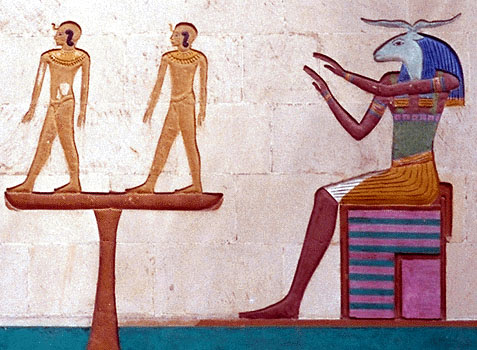
4- See Colorful Paintings of the Zodiac Signs From an Ancient Egyptian Temple
Newly restored, the Ptolemaic era reliefs were previously covered by a layer of dirt and soot
April 4, 2023 Christopher Parker
PS -For a more recent use of this type of research on 19th century sources, albeit with all the more mystical, theosophical perspectives removed, Blavatsky's research, but with more conservative conclusions, if you will, see
Acharya S, Suns Of God; Krishna, Buddha, And Christ Unveiled ( 2004)


 Jupiter sextile Saturn transit is a time of cautious
expansion. Some growth opportunities are likely to be offered, and you can rely
on sound judgment skills to choose only those right for you. These
opportunities may be in your career, through investment or business deals, or
in your personal life as significant material possessions or relationship
choices.
Jupiter sextile Saturn transit is a time of cautious
expansion. Some growth opportunities are likely to be offered, and you can rely
on sound judgment skills to choose only those right for you. These
opportunities may be in your career, through investment or business deals, or
in your personal life as significant material possessions or relationship
choices.


,_N372.2.jpg)




#/media/File:Nandibull.jpg)
#/media/File:Nandieshvara.jpg )
#/media/File:Api_or_Hapi_(Apis,_Taureau_Consacr%C3%A9_a_la_Lune),_N372.2.jpg )


